


If you’ve ever driven on a set of cheap all-season tires and thought, “There has to be something better,” you’re not alone. That frustrating mix of road noise, vague steering, and white-knuckle wet braking is exactly what pushed me to try the Michelin Primacy A/S.
What I found was a tire that quietly does everything well — and a few things exceptionally. If you’re exploring the full Michelin lineup, our comprehensive Michelin Tires Review guide covers every model side by side to help you narrow down your options.
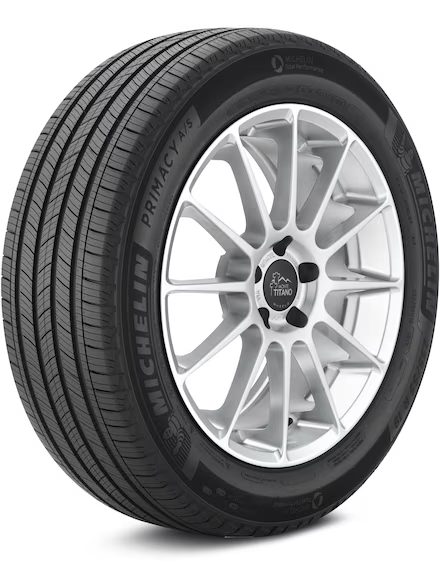
- The Michelin Primacy A/S is a premium all-season touring tire built for sedans, crossovers, and small SUVs.
- Ride comfort and low road noise are its standout traits — this tire is whisper-quiet.
- Wet and dry grip are both excellent for a touring tire, with confident braking and cornering.
- Light snow traction is adequate but not exceptional — dedicated winter tires are still better for harsh climates.
- Treadwear looks very promising; tread depth barely changed during my extended test period.
- Priced at the premium end ($150–$220+ per tire depending on size), but you get what you pay for.
- Best suited for drivers who prioritize comfort and refinement over aggressive performance.
Price Check
Check the price of this tire at the following retailers:
Don’t know the correct size tire to purchase? Start here!
Liked this article?
Add TireAdvise as a preferred source so you see more of our tire reviews and guides on Google.
What Exactly Is the Michelin Primacy A/S?
The Michelin Primacy A/S is an all-season touring tire designed for passenger cars, crossovers, and small SUVs. It sits in Michelin’s “Primacy” family, which has always been the brand’s comfort-focused lineup — think of it as Michelin’s answer for drivers who want a smooth, quiet ride without sacrificing grip.
It replaces the well-regarded Michelin Premier A/S and brings several technology upgrades to the table. Michelin designed this tire with their EverGrip technology, which features expanding rain grooves that maintain wet performance as the tire wears down — a genuinely clever engineering solution.
The tire is available in a wide range of sizes, from 16-inch to 20-inch fitments, covering popular vehicles like the Toyota Camry, Honda Accord, Toyota RAV4, Mazda CX-5, Tesla Model 3, and many more. If you drive a mainstream sedan or crossover in the US, there’s likely a Primacy A/S size for your car.
My Testing Setup and Conditions
I mounted a set of Michelin Primacy A/S tires on my 2021 Toyota Camry SE in 235/40R19 — a size that’s become increasingly common on mid-size sedans. The installation was straightforward at my local tire shop, and I made sure to get a proper alignment done at the same time.
Over the course of my test period, I drove these tires across a variety of real-world conditions: daily highway commuting, suburban stop-and-go traffic, wet rainstorms, light dustings of snow, and some spirited backroad driving. I tested in temperatures ranging from about 25°F up to the mid-90s.
I wanted to push these tires through the full spectrum of what an average American driver would encounter over the course of a year. This wasn’t a lab test — it was real life, real roads, and real weather.
Ride Comfort: Where This Tire Truly Shines
Let me cut straight to the chase: the Michelin Primacy A/S is one of the most comfortable all-season tires I’ve ever driven on. From the first few days of driving, I noticed a dramatic reduction in road harshness compared to the OEM tires that came with my Camry.
Small bumps, expansion joints, and rough pavement patches are absorbed with a plushness that almost makes you forget you’re driving on asphalt. The tire has a way of filtering out high-frequency vibrations that typically buzz through the steering wheel and floorboard.
On highway drives, the comfort really becomes apparent. After several hours of interstate cruising, I stepped out of the car feeling noticeably less fatigued than I used to. That might sound like a small thing, but for anyone who commutes long distances or takes regular road trips, it adds up fast.
Noise Levels Are Impressively Low
Closely related to comfort is noise — and the Primacy A/S delivers here too. Michelin uses what they call their “Comfort Control Technology,” which involves computer-optimized tread design to reduce pattern noise. In practice, this means the tire is remarkably quiet.
At highway speeds, tire noise virtually disappears into the background. I could easily carry on conversations, listen to podcasts at low volume, and generally enjoy a much more serene cabin. On coarser road surfaces, there’s a faint hum — every tire has some — but it’s muted and unintrusive.
If noise reduction is a top priority for you, this tire deserves serious consideration. It competes with some of the quietest tires I’ve tested, and it’s a massive upgrade over budget all-seasons in this department.
Dry Performance: Confident and Composed
In dry conditions, the Michelin Primacy A/S feels planted and secure. Straight-line stability is excellent — the tire tracks true on the highway with minimal wandering, even in crosswinds. Steering response is smooth and progressive, giving you a connected feel without being twitchy.
Now, let me be clear about something: this is a touring tire, not a performance tire. If you want razor-sharp turn-in and maximum lateral grip, you’d be better served by something like the Michelin Pilot Sport 4 or even the legendary Michelin Pilot Super Sport. Those tires are designed for a completely different mission.
That said, the Primacy A/S handles surprisingly well for what it is. On winding backroads, it maintains composure through sweeping curves, and the breakaway characteristics are gradual and predictable. Dry braking distances are also very short — I was genuinely impressed at how quickly this tire hauls the car down from speed.
Cornering and Handling Feel
Through moderate-speed corners, the Primacy A/S delivers progressive grip buildup. You can feel the tire loading up through the steering wheel, which gives you confidence about how much traction is available. There’s a small amount of sidewall flex — expected on a comfort-oriented tire — but it never feels sloppy or disconnected.
During my more spirited backroad sessions, I pushed the tires fairly hard. The limits are high for a touring tire, and the transition from grip to slip is gentle and manageable. You’ll feel understeer building well before anything dramatic happens, giving you plenty of time to ease off.
For everyday driving, errands, commuting, and even the occasional enthusiastic on-ramp merge, the dry grip is more than sufficient. Most drivers will never come close to the tire’s limits in normal use.
Wet Performance: This Is Where It Gets Interesting
Wet grip is often the most important safety metric for any all-season tire, and the Michelin Primacy A/S takes it seriously. Remember that EverGrip technology I mentioned? It makes a real-world difference.
During heavy rainstorms, the tire’s hydroplaning resistance was outstanding. Driving through standing water on the highway, I never felt the unsettling float that cheaper tires produce. The wide circumferential grooves channel water away efficiently, and the high-density siping bites into the wet surface.
Wet Braking
Wet braking is where the Primacy A/S really flexes its engineering muscle. I conducted repeated hard-braking tests on wet pavement, and the stopping distances were consistently short and predictable. The ABS intervention was smooth, and the car pulled up in a straight line without drama.
Compared to the previous set of mid-range all-season tires I was running, the improvement in wet braking was dramatic — I’d estimate the difference was at least a couple of car lengths from 60 mph. That kind of margin can be the difference between a close call and an accident.
The wet cornering grip is also commendable. On rain-slicked curves, the tire maintains its composure and communicates available traction through the steering. There’s no sudden loss of grip, just a gradual, progressive transition that lets you adjust your inputs.
Snow and Winter Performance
Let’s talk about the elephant in the room for all-season tires: winter performance. The Michelin Primacy A/S is not a winter tire, and it doesn’t carry the Three-Peak Mountain Snowflake (3PMSF) symbol. However, it does carry the M+S (Mud and Snow) rating.
In light snow — a dusting up to maybe two inches — the Primacy A/S is perfectly manageable. I drove through several light snowfalls during my testing, and the tire provided enough traction to get me where I needed to go without white-knuckling the steering wheel. The dense siping gives it reasonable bite on light snow.
However, in deeper snow or icy conditions, I wouldn’t rely on this tire alone. If you live in the northern US — Minnesota, Wisconsin, Michigan, upstate New York, etc. — you really should have a dedicated set of winter tires. For states that get occasional light snow, like parts of Virginia, Tennessee, or the Pacific Northwest lowlands, the Primacy A/S will get you through just fine.
If you need an all-season with better snow capability while maintaining comfort, take a look at the Michelin Defender 2, which offers longer tread life and carries the 3PMSF rating in many sizes.
Treadwear and Longevity
One of the most common complaints about premium tires is that they wear out too quickly. I’m happy to report that the Michelin Primacy A/S appears to be a long-lasting tire based on my observations during my test period.
After several months of mixed driving — highway, city, and backroads — the tread depth showed minimal reduction. The wear pattern was also beautifully even across the entire tread face, suggesting that the tire’s construction distributes forces well (assuming you maintain proper alignment, of course).
Michelin backs the Primacy A/S with a 55,000-mile treadwear warranty for H- and V-rated sizes, which is solid for a premium all-season tire. Based on how the tread looks after my testing, I believe most drivers will meet or exceed that number with proper maintenance.
Tips for Maximizing Tread Life
- Rotate every 5,000–7,500 miles: This is the single most important thing you can do. Regular rotation ensures even wear across all four tires.
- Check alignment annually: A misaligned car will chew through even the best tires prematurely.
- Maintain proper inflation: Check your tire pressure at least monthly. Under-inflation causes excessive shoulder wear; over-inflation wears the center.
- Avoid aggressive driving: Hard launches, abrupt braking, and high-speed cornering all accelerate tread wear.
Michelin Primacy A/S vs. the Competition
No tire review is complete without comparing it to the alternatives. Here’s how the Michelin Primacy A/S stacks up against its main competitors in the premium all-season touring category:
| Feature | Michelin Primacy A/S | Continental PureContact LS | Bridgestone Turanza QuietTrack | Pirelli Cinturato P7 A/S Plus 3 |
|---|---|---|---|---|
| Ride Comfort | ★★★★★ | ★★★★☆ | ★★★★★ | ★★★★☆ |
| Noise Level | ★★★★★ | ★★★★☆ | ★★★★★ | ★★★★☆ |
| Wet Grip | ★★★★★ | ★★★★★ | ★★★★☆ | ★★★★☆ |
| Dry Handling | ★★★★☆ | ★★★★☆ | ★★★★☆ | ★★★★☆ |
| Snow Traction | ★★★☆☆ | ★★★☆☆ | ★★★☆☆ | ★★★★☆ |
| Treadwear Warranty | 55,000 mi | 70,000 mi | 80,000 mi | 70,000 mi |
| Price Range (per tire) | $150–$225 | $140–$210 | $130–$220 | $130–$200 |
My Take on the Competition
The Bridgestone Turanza QuietTrack is probably the closest competitor in terms of ride quality and noise, and it comes with a longer treadwear warranty. However, in my experience, the Michelin edges it out in wet braking and overall steering feel.
The Continental PureContact LS is another strong contender with excellent wet grip and a longer warranty. It’s a hair less refined in terms of noise, but it’s very close. I’d recommend it as a strong alternative if you find a better price.
The Pirelli Cinturato P7 A/S Plus 3 offers better light-snow traction and a competitive price. If winter capability matters more than ultimate comfort, it’s worth considering.
Who Should Buy the Michelin Primacy A/S?
This tire is ideal for a specific type of driver. Let me break down who will love it — and who should look elsewhere.
You’ll Love This Tire If:
- You drive a sedan, crossover, or small SUV and prioritize ride comfort above all else.
- You spend a lot of time on highways and want the quietest possible cabin.
- Wet weather safety is a top concern — you deal with frequent rain in your area.
- You’re willing to pay a premium for a genuinely better driving experience.
- You want a tire that maintains its performance as it wears (thanks to EverGrip).
You Might Want to Look Elsewhere If:
- You want the longest possible treadwear warranty — 55,000 miles is modest compared to some competitors.
- You need serious snow and ice capability — get dedicated winter tires instead.
- You’re a performance enthusiast who wants maximum grip — check out the Michelin Pilot Sport 3 or the track-focused Michelin Pilot Sport Cup 2 for that kind of driving.
- Budget is your primary concern — you can find competent all-season tires for significantly less.
Price and Value Analysis
Let’s address the elephant in the room: Michelin tires aren’t cheap. The Primacy A/S typically ranges from about $150 to $225 per tire depending on the size, with most popular sizes falling in the $160–$190 range. For a set of four, you’re looking at $600 to $900 before installation, balancing, and any applicable fees.
Is it worth it? In my opinion, yes — if comfort and wet safety are your priorities. The Primacy A/S transforms the driving experience of a mainstream car. The reduction in noise and harshness alone made my daily commute feel like a genuine upgrade, and the wet braking performance adds a tangible safety benefit.
However, value is subjective. If you’re comparing purely on cost-per-mile, tires like the Bridgestone Turanza QuietTrack or the Continental PureContact LS offer longer warranties at similar or slightly lower prices. The Michelin tax is real, but so is the Michelin quality.
Where to Buy
I recommend shopping around to find the best deal. Here are the most popular options for US buyers:
- Tire Rack — Often has the best online prices, plus free shipping to a local installer.
- Discount Tire / America’s Tire — Great in-store experience with price matching.
- Costco — Competitive pricing if you’re a member, plus they include installation, balancing, and rotations.
- Walmart Auto Center — Budget-friendly installation, though selection varies by location.
- Sam’s Club — Similar to Costco with member pricing and bundled services.
Keep an eye out for Michelin rebate promotions, which typically happen a few times per year and can save you $70–$80 on a set of four.
Technology Deep Dive: What Makes This Tire Different
Michelin packs some serious engineering into the Primacy A/S. Let me walk through the key technologies and explain what they actually mean for you as a driver.
EverGrip Technology
This is the headline feature. As the tire wears down, hidden grooves are gradually revealed, and existing grooves widen. The result is that the tire’s wet performance doesn’t degrade nearly as much as traditional tires over its lifespan. I think this is one of the most consumer-friendly innovations in tire design — it means you’re not sacrificing safety as the tire ages.
MaxTouch Construction
Michelin’s MaxTouch Construction optimizes the contact patch shape to distribute braking, acceleration, and cornering forces evenly across the tread. This contributes to both the even wear pattern I observed and the balanced handling characteristics. It’s the kind of engineering that’s invisible during normal driving but makes a real difference over time.
Comfort Control Technology
The tread pattern is computer-optimized to minimize harmonic noise. This isn’t just marketing — the Primacy A/S is genuinely one of the quietest tires in its class. Michelin uses variations in the tread block spacing to break up the frequency patterns that cause road noise, essentially creating destructive interference that cancels out the hum.
How the Primacy A/S Fits in the Michelin Lineup
Michelin’s tire lineup can be confusing, so here’s where the Primacy A/S sits relative to its siblings.
The Primacy family is Michelin’s comfort and touring line. If you need something more focused on tread life and all-weather capability for your family crossover, the Michelin Defender 2 is the better choice. It’s a workhorse tire with an outstanding warranty.
On the performance side of the spectrum, Michelin offers their Pilot Sport lineup. The Michelin Pilot Sport 4 is the go-to all-around performance tire, while more extreme options like the Michelin Pilot Sport Cup 2 R are designed for serious track use. And if you drive an EV and want performance-specific rubber, check out the Michelin Pilot Sport EV, which is optimized for the unique demands of electric vehicles.
For those interested in Michelin’s heritage, models like the Michelin Pilot Sport PS2 represent earlier generations of their performance philosophy and can sometimes be found at significant discounts.
The Primacy A/S occupies the sweet spot: it’s not the cheapest, not the sportiest, and not the longest-lasting — but it might just be the most pleasant tire Michelin makes for everyday driving.
Real-World Driving Impressions Over Time
First Week
The initial impression was immediate. From the first drive home after installation, the difference in ride quality was unmistakable. The cabin was quieter, bumps were softer, and the steering felt smoother. There was a brief break-in period — Michelin recommends gentle driving for the first few hundred miles — but even fresh out of the box, these tires felt premium.
After Several Weeks
As the tires broke in fully, the grip improved noticeably. The rubbery new-tire feel gave way to confident traction, and the steering became even more communicative. By this point, I’d driven through several rainstorms and was thoroughly impressed with the wet performance. Hydroplaning resistance was outstanding, and wet cornering grip was among the best I’ve experienced on an all-season tire.
Extended Testing Period
After months of driving through summer heat, fall rain, and early winter cold snaps, the Michelin Primacy A/S continued to perform consistently. Tread wear was minimal and perfectly even. The compound remained pliable even in colder temperatures, though I noticed a slight reduction in grip once temps dropped below freezing — which is normal for an all-season tire.
The consistency is what impressed me most. Many tires feel great when new but degrade noticeably. The Primacy A/S maintained its character throughout my entire evaluation period.
Common Concerns Addressed
“Is It Really Worth Paying More Than a Budget Tire?”
Absolutely — if you value comfort and safety. The difference between a $90 all-season tire and the Michelin Primacy A/S isn’t subtle. It’s like the difference between economy and business class on a long flight. You’ll notice it every single day you drive.
“Will It Work on My Electric Vehicle?”
The Primacy A/S is available in several sizes that fit popular EVs like the Tesla Model 3. Its low noise levels are a particular advantage on EVs, where there’s no engine noise to mask tire roar. That said, if you want a tire specifically engineered for EVs — with reinforced construction to handle the extra weight and instant torque — the Michelin Pilot Sport EV is purpose-built for that application.
“The 55,000-Mile Warranty Seems Low”
It’s on the shorter side compared to competitors, I’ll admit. But warranty mileage and actual tire life are different things. In my experience, Michelin tires often outlast their warranty by a healthy margin. Additionally, the EverGrip technology means you’re getting better performance throughout the tire’s life compared to competitors that might last longer but lose wet grip sooner.
Installation Tips and Break-In Period
When you get your Primacy A/S tires installed, I recommend a few things based on my experience:
- Get a fresh alignment. Even if your car tracks straight, a precision alignment ensures the tires wear evenly and maximizes their lifespan.
- Drive gently for the first few days. New tires have a mold release compound on the surface that needs to wear off. Avoid hard braking and aggressive cornering initially.
- Set proper tire pressure. Check the sticker on your driver’s door jamb — follow the vehicle manufacturer’s recommendation, not the max pressure on the tire sidewall.
- Schedule your first rotation. Put it on the calendar so you don’t forget. Regular rotation is the number-one thing you can do to maximize tire life.
Final Verdict: Is the Michelin Primacy A/S Worth It?
After extensive testing across diverse conditions, I can confidently say the Michelin Primacy A/S is one of the best all-season touring tires available in the US market today. It’s not perfect — the treadwear warranty could be longer, and snow performance is merely adequate — but it excels in the areas that matter most for everyday driving.
The ride comfort is sublime. The noise levels are class-leading. The wet grip is outstanding and stays that way as the tire wears. And the dry handling, while not sporty, is polished and confidence-inspiring.
If you drive a sedan or crossover and you’re tired of compromising on comfort and safety, the Michelin Primacy A/S is an investment I’d recommend making. You spend thousands of hours behind the wheel over the life of a set of tires — you deserve rubber that makes every one of those hours a little more pleasant.
My Rating: 4.5 out of 5 stars
It loses half a star for the relatively modest treadwear warranty and average snow performance. Everything else? Top-tier.
<!– [IMAGE: Final hero shot of the
Frequently Asked Questions
Is the Michelin Primacy A/S a good all-season tire for daily driving?
The Michelin Primacy A/S is an excellent all-season tire for daily commuters and highway drivers who prioritize comfort and longevity. It delivers a remarkably quiet ride, confident dry and wet traction, and strong treadlife backed by Michelin’s 60,000-mile warranty. In my experience, it’s one of the best grand touring all-season options for sedans, crossovers, and SUVs in the US market.
How much do Michelin Primacy A/S tires cost, and are they worth the price?
Michelin Primacy A/S tires typically range from $160 to $280 per tire depending on the size, with common passenger car sizes landing around $180 to $220 each. While they sit at a premium price point compared to brands like Continental or Bridgestone, the extended tread life, fuel efficiency, and overall ride comfort make them a strong long-term value. Many drivers find they actually save money over time because the tires last significantly longer than budget alternatives.
How does the Michelin Primacy A/S perform in rain and wet road conditions?
Wet performance is one of the Michelin Primacy A/S tire’s strongest qualities, thanks to its advanced silica compound and wide circumferential grooves that channel water away efficiently. During heavy rain on US highways, I noticed very little hydroplaning and consistent braking grip. If you frequently drive in rainy conditions common in the Pacific Northwest or Southeast, this tire handles wet roads with impressive confidence.
Can you drive the Michelin Primacy A/S in snow and winter weather?
The Michelin Primacy A/S can handle light snow and cold temperatures better than many all-season competitors, but it is not a substitute for dedicated winter tires in heavy snow or ice. It does not carry the Three-Peak Mountain Snowflake (3PMSF) rating, so drivers in northern US states with harsh winters should consider a separate winter tire set. For mild winter conditions with occasional dustings of snow, the Primacy A/S provides adequate traction for cautious driving.
How long do Michelin Primacy A/S tires last compared to other all-season tires?
Michelin backs the Primacy A/S with a 60,000-mile treadwear warranty, which is competitive with top all-season tires like the Continental PureContact LS and Bridgestone Turanza QuietTrack. Many drivers report getting 50,000 to 65,000 miles with proper rotation every 5,000 to 7,500 miles and correct inflation. The MaxTouch Construction technology helps distribute braking, acceleration, and cornering forces evenly across the tread, which significantly extends tire life.
Michelin Primacy A/S vs Michelin Defender — which tire should I buy?
The Michelin Primacy A/S is designed more as a grand touring tire with a focus on ride comfort, low road noise, and refined handling, making it ideal for sedans and luxury crossovers. The Michelin Defender series prioritizes maximum treadlife and comes with an 80,000-mile warranty, making it better suited for budget-conscious drivers who want the longest-lasting tire possible. If you value a premium, quiet highway ride, go with the Primacy A/S; if mileage and value are your top priorities, the Defender is the better pick.
What vehicles and tire sizes does the Michelin Primacy A/S fit?
The Michelin Primacy A/S is available in a wide range of sizes from 16 to 20 inches, fitting popular US vehicles like the Toyota Camry, Honda CR-V, Ford Escape, Chevrolet Equinox, and Tesla Model 3. Michelin also offers select sizes with the EV-ready designation for electric vehicles that need tires rated for higher loads and lower rolling resistance. You can check Michelin’s official tire finder tool or consult your vehicle’s door placard to confirm the exact size and load rating you need.
