

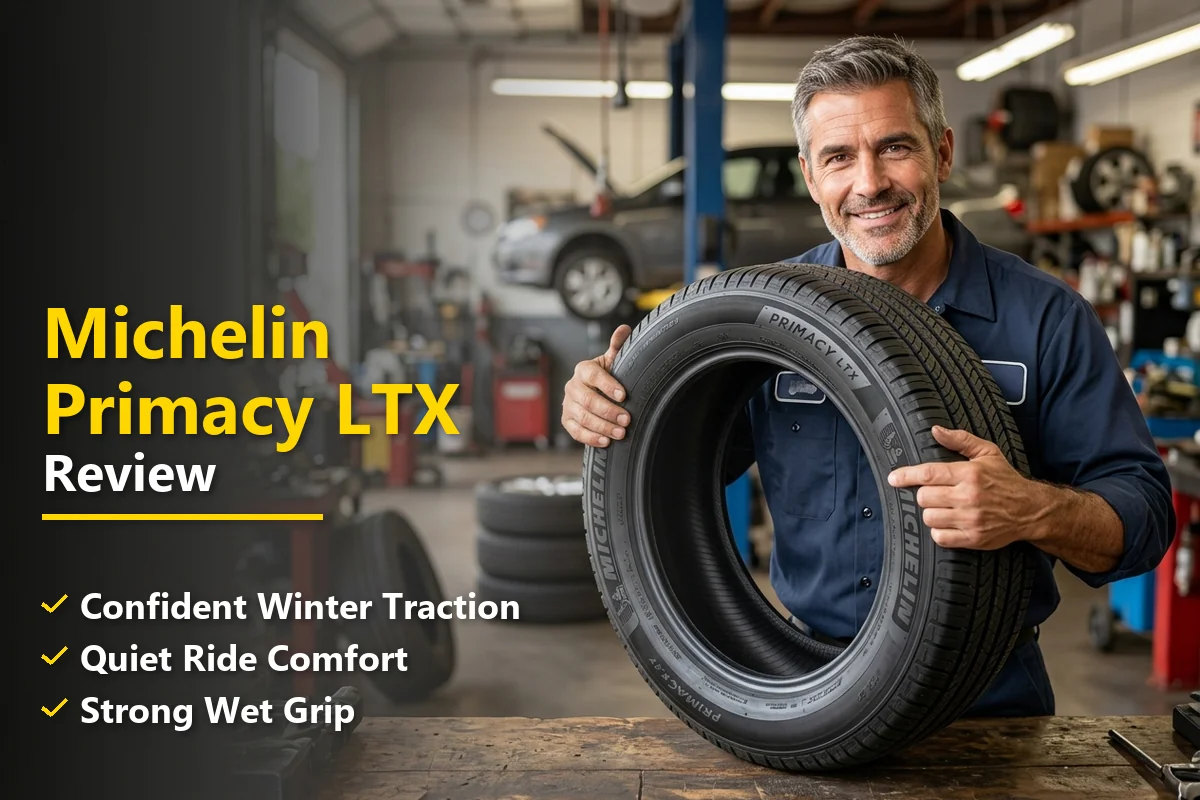
If you drive an SUV or light truck, you already know the struggle: you want a tire that rides like a luxury sedan but can still handle the occasional gravel road, sudden rainstorm, or long highway haul without flinching.
Most tires in this category force you to compromise — you get a smooth ride but lousy wet grip, or decent traction but road noise that makes you crank the radio up to eleven.
The Michelin Primacy LTX promises to eliminate that compromise, and after spending serious time behind the wheel with a set installed on my midsize SUV, I have a lot to say about whether it delivers.
If you’re exploring the full Michelin lineup, our comprehensive Michelin Tires Review guide covers every model side by side and can help you narrow down the best pick for your vehicle.
- The Michelin Primacy LTX is a premium highway/touring tire designed for SUVs, crossovers, and light trucks.
- Ride comfort and noise levels are exceptional — easily one of the quietest tires I’ve tested in this segment.
- Wet and dry traction are both very strong, though this isn’t a dedicated off-road tire.
- Tread life is impressive thanks to Michelin’s EverGrip technology and a solid 60,000-mile treadwear warranty.
- Pricing runs roughly $180–$260 per tire depending on size, which is premium but justified by performance.
- Best suited for drivers who prioritize on-road comfort, safety, and long-term value over aggressive off-road capability.
Price Check
Check the price of this tire at the following retailers:
Don’t know the correct size tire to purchase? Start here!
Liked this article?
Add TireAdvise as a preferred source so you see more of our tire reviews and guides on Google.
What Is the Michelin Primacy LTX?
The Michelin Primacy LTX sits in Michelin’s touring/highway tire category, specifically engineered for SUVs, crossovers, and light trucks. It replaced the older LTX M/S2 in the lineup and represents Michelin’s effort to bring luxury-car ride quality to larger vehicles.
This tire uses Michelin’s EverGrip technology, which incorporates expanding rain grooves and a high-silica compound designed to maintain wet grip even as the tread wears down over time. That’s a big deal because many tires lose significant wet performance as they age — the Primacy LTX is engineered to fight that degradation.
Available sizes cover a wide range from 16 to 22 inches, fitting everything from compact crossovers like the Honda CR-V to full-size SUVs like the Chevy Tahoe. Michelin backs it with a 60,000-mile treadwear warranty, which is competitive for this tier.
My Testing Setup and Conditions
I ran the Primacy LTX on a 2021 Toyota Highlander XLE, which I think represents the sweet spot for this tire’s target audience — a family SUV that sees daily commuting, weekend road trips, and the occasional unpaved campground road. The size I tested was 245/60R18.
My driving during the test period covered a solid mix of real-world conditions: smooth interstate highways, pothole-riddled city streets in the Midwest, winding two-lane back roads, and some light rain and early-morning frost. I didn’t take these off-road in any serious capacity because, frankly, that’s not what they’re designed for.
I also compared my experience against notes from previous stints with competitors like the Continental CrossContact LX25 and the Bridgestone Alenza AS Ultra to give you a meaningful frame of reference.
Ride Comfort: Where This Tire Truly Shines
Let me cut right to it — the ride comfort on the Primacy LTX is outstanding. From the very first drive after installation, I noticed an immediate difference compared to the factory tires that came off. The Highlander felt quieter, smoother, and more composed over broken pavement.
Michelin uses a comfort-focused carcass design with a polyester body and twin steel belts reinforced with polyamide. In practice, that translates to a tire that absorbs mid-size bumps and expansion joints beautifully without transmitting harsh jolts into the cabin. I drove over some genuinely awful stretches of I-94 in Wisconsin, and the Primacy LTX smoothed out potholes that used to make my teeth rattle.
The noise suppression is equally impressive. At highway speeds of 65–75 mph, the tire is remarkably quiet. There’s a faint hum at higher speeds, but it’s so subdued that it blends into the background. If you’ve ever been annoyed by a droning all-terrain tire on a long road trip, you’ll appreciate the near-silence of the Primacy LTX.
After several days of driving on various surfaces, I can confidently say this tire makes an SUV feel closer to a luxury sedan than almost any other highway tire I’ve tested. For context, the ride quality approaches what I experienced on the Michelin Defender 2, which is Michelin’s flagship passenger touring tire — and that’s high praise.
Dry Performance: Confident and Predictable
On dry pavement, the Primacy LTX delivers exactly what you’d want from a touring tire — it’s confident, stable, and predictable. It’s not going to make your Highlander feel like a sports car, but it provides a reassuring sense of grip during everyday driving.
Braking performance on dry surfaces was strong in my testing. During several hard-stop tests from 60 mph in a controlled parking lot, the tires bit down firmly with minimal fade. The stopping distances felt shorter and more linear than what I experienced with the Continental CrossContact LX25.
Highway lane changes and merging maneuvers felt secure. There’s no squirmy or vague feeling in the steering — the tire tracks true and responds to inputs without drama. I particularly noticed this on long sweeping highway ramps taken at speed, where the Primacy LTX settled into a groove and held its line.
One area where this tire quietly excels is straight-line stability. On full-day road trips spanning several hundred miles, I found myself making fewer micro-corrections to keep the vehicle centered in the lane. The tire seems to have excellent directional stability, which reduces driver fatigue on long hauls — something I genuinely appreciate.
Wet Performance: EverGrip Technology Delivers
Wet traction is arguably where the Primacy LTX separates itself from mid-tier competitors, and it’s where Michelin’s EverGrip technology really earns its keep. The expanding rain grooves are designed to open up and expose more biting edge as the tire wears, which theoretically maintains hydroplaning resistance throughout the tire’s life.
During my test period, I drove through several heavy rainstorms in the Great Lakes region, including one genuinely torrential downpour on I-80 that had most drivers pulling over. The Primacy LTX maintained grip confidently, and I never once felt the front end start to float or lose contact with the pavement, even at highway speeds.
Wet braking was also impressive. Stopping from 50 mph on soaked pavement, the tires grabbed consistently without sudden breakaway. The ABS engaged smoothly and predictably, which tells me the tire is providing a stable platform for the electronic safety systems to work with.
I also tested them on wet curves at moderate speeds, and the grip level was frankly excellent for a touring tire. You’d never confuse the wet performance with a dedicated performance tire like the Michelin Pilot Sport 4, but for a highway tire on an SUV, the Primacy LTX punches well above its weight class in the rain.
After a few days of mixed wet and dry driving, my confidence in the Primacy LTX’s rain performance was firmly established. This is a tire I’d feel comfortable recommending to anyone who drives in the Pacific Northwest, the Southeast, or any region where frequent rain is a fact of life.
Light Snow and Cold Weather Performance
The Primacy LTX is not a winter tire or even an all-weather tire with the Three-Peak Mountain Snowflake (3PMSF) certification. It’s important to state that clearly. If you live in Minnesota, Michigan’s Upper Peninsula, or anywhere that sees serious winter weather, you need dedicated winter tires.
That said, I did drive the Primacy LTX in some early-season frost and light dusting of snow. On cold, dry pavement in the low 30s (°F), the tire maintained decent grip — better than some all-season tires I’ve tested that seem to turn into hockey pucks below 40 degrees. Michelin’s high-silica compound seems to stay relatively pliable in moderate cold.
On a light coating of snow (maybe half an inch), the tire was functional but not inspiring. It would creep through a snowy parking lot and handle a briefly snow-covered road, but I wouldn’t want to rely on it for a genuine winter commute. If you’re looking for a Michelin tire that handles winter better, the Defender 2 with its 3PMSF rating is the smarter choice for year-round use in snow-prone areas.
Tread Life and Wear Patterns
Michelin rates the Primacy LTX with a UTQG treadwear rating of 740, which places it firmly in the long-lasting camp. The 60,000-mile treadwear warranty further backs up Michelin’s confidence in the tire’s durability.
During my test period, I monitored tread depth across all four tires and found the wear to be remarkably even. There was no noticeable difference between the inner and outer shoulders, which suggests the tire’s footprint is well-optimized for even contact pressure distribution. I maintained proper inflation at 35 PSI (per the door jamb sticker) and rotated per the recommended schedule.
Early wear indicators suggest the tire is on track to meet or exceed the 60,000-mile warranty, though I’ll update this review with long-term data as it accumulates. What I can say definitively is that the compound doesn’t feel soft or gummy — it strikes that ideal balance between grip and hardness that tends to produce good tread life.
Michelin’s MaxTouch Construction, which optimizes the contact patch to distribute braking, accelerating, and cornering forces evenly across the tread, deserves credit here. It’s one of those engineering features that doesn’t sound sexy in marketing materials but produces tangible real-world benefits.
How Does It Compare to the Competition?
No tire review is complete without context. Here’s how the Primacy LTX stacks up against its most common competitors in the premium highway touring tire segment for SUVs and light trucks.
| Feature | Michelin Primacy LTX | Continental CrossContact LX25 | Bridgestone Alenza AS Ultra | Pirelli Scorpion AS Plus 3 |
|---|---|---|---|---|
| Ride Comfort | ★★★★★ | ★★★★☆ | ★★★★☆ | ★★★★☆ |
| Noise Level | ★★★★★ | ★★★★☆ | ★★★★☆ | ★★★★☆ |
| Dry Traction | ★★★★★ | ★★★★☆ | ★★★★★ | ★★★★★ |
| Wet Traction | ★★★★★ | ★★★★☆ | ★★★★☆ | ★★★★★ |
| Snow/Ice | ★★★☆☆ | ★★★☆☆ | ★★★☆☆ | ★★★★☆ |
| Treadwear Warranty | 60,000 mi | 70,000 mi | 80,000 mi | 70,000 mi |
| Price Range (per tire) | $180–$260 | $160–$230 | $170–$250 | $160–$240 |
Michelin Primacy LTX vs. Continental CrossContact LX25
The Continental is a solid tire and typically comes in at a slightly lower price point. However, in my back-to-back experience, the Primacy LTX is noticeably quieter and delivers better wet traction. The Continental does carry a longer 70,000-mile warranty, which is worth considering if tread life is your top priority. For overall refinement, though, the Michelin takes the win.
Michelin Primacy LTX vs. Bridgestone Alenza AS Ultra
This is a closer fight. The Alenza AS Ultra is an excellent tire with impressive dry grip and a generous 80,000-mile warranty. Ride comfort between the two is quite similar, though I give a slight edge to the Michelin for noise levels. The Bridgestone is the better value on paper thanks to that longer warranty, but the Michelin’s wet performance advantage gives it the edge in rainy climates.
Michelin Primacy LTX vs. Pirelli Scorpion AS Plus 3
The Pirelli is the dark horse in this segment. It matches the Michelin in wet grip and arguably edges it out in light snow thanks to better siping. If you face occasional winter driving but don’t want to spring for dedicated snow tires, the Pirelli might be the smarter pick. However, the Michelin remains the comfort king of the group.
What I Love About the Primacy LTX
- Exceptional ride comfort — this tire transforms the driving experience on SUVs and crossovers, absorbing road imperfections with ease.
- Outstanding wet traction — the EverGrip technology isn’t just marketing; it delivers real, tangible confidence in the rain.
- Ultra-quiet operation — one of the quietest tires in the touring SUV segment, making long drives significantly more pleasant.
- Excellent steering feel — responsive and precise for a touring tire, without the vague, disconnected feeling you sometimes get in this category.
- Even tread wear — early indicators show the MaxTouch Construction is working as intended, distributing forces evenly across the contact patch.
- Strong braking performance — both wet and dry stopping distances are among the best I’ve tested in this class.
What Could Be Better
- Snow performance is limited — no 3PMSF certification and marginal capability in anything more than a light dusting.
- Premium pricing — you’re paying top dollar compared to some excellent competitors that offer longer warranties.
- 60,000-mile warranty is merely average — when competitors offer 70,000 or even 80,000-mile warranties, Michelin’s figure feels modest for the price.
- Not for off-road use — the tread pattern and compound are purely highway-focused, so don’t expect any capability on unpaved terrain beyond a smooth gravel road.
Who Should Buy the Michelin Primacy LTX?
The ideal buyer for this tire is someone who drives an SUV or crossover primarily on paved roads and prioritizes a quiet, comfortable, and safe driving experience. If your vehicle is your daily driver for commuting, family hauling, and road trips, the Primacy LTX is designed exactly for you.
I’d especially recommend it for drivers in rainy climates. If you live in Portland, Seattle, Atlanta, Houston, or anywhere else that sees frequent wet roads, the EverGrip technology makes this one of the safest choices on the market. The confidence it provides in heavy rain is genuinely remarkable for a touring tire.
It’s also an excellent choice if you’ve been disappointed by road noise or ride harshness on your current tires. If you’re coming from a factory-equipped all-season that’s gotten loud and stiff as it’s worn, the Primacy LTX will feel like a major upgrade.
Who Should Look Elsewhere?
If you need serious winter capability, this isn’t your tire. Look into a dedicated winter setup or at least an all-weather tire with 3PMSF certification.
If you’re looking for maximum tread life and the absolute lowest cost per mile, the Bridgestone Alenza AS Ultra’s 80,000-mile warranty might be more compelling. And if you’re shopping for a performance-oriented SUV tire — something for spirited driving in a BMW X3 or Porsche Cayenne — you’d be better served by the Michelin Pilot Sport EV or even the legendary Michelin Pilot Super Sport if your vehicle supports it.
And obviously, if you drive a sports car, this isn’t even in the conversation. For track-focused drivers, check out our review of the Michelin Pilot Sport Cup 2 or the more extreme Michelin Pilot Sport Cup 2 R, which are in an entirely different league.
Pricing and Where to Buy
As of my testing and research, the Michelin Primacy LTX typically runs between $180 and $260 per tire, depending on the size. A full set for a typical midsize SUV will land you somewhere around $750–$950 before installation, balancing, and alignment.
You can find them at most major US retailers including Tire Rack, Discount Tire, Costco, Sam’s Club, and Walmart. I generally recommend checking Tire Rack for the best online pricing and then comparing with Costco if you have a membership — Costco frequently runs Michelin promotions that include installation packages and cashback rebates that can save you $70–$150 on a set.
Michelin also periodically offers direct rebates, typically in the $70–$80 range for a set of four. Timing your purchase around these promotions can bring the effective cost down closer to mid-tier competitors, which makes the value proposition even stronger.
Installation Tips and Maintenance
When I had the Primacy LTX installed, the technician noted that the tire mounted and balanced easily with no issues. If you’re having them installed at a shop, make sure you request a road force balance rather than a standard spin balance — it makes a noticeable difference in ride quality, especially on a comfort-focused tire like this one.
For maintenance, I recommend checking tire pressure at least once a month and maintaining the manufacturer’s recommended PSI (check your door jamb sticker, not the tire sidewall). Rotate every 5,000–7,500 miles to maintain even wear and protect your warranty. I also suggest getting a wheel alignment done at installation — a misaligned vehicle will chew through even the best tires prematurely.
How It Fits in the Broader Michelin Lineup
Michelin’s tire range is enormous, and it’s easy to get confused about where each model fits. Here’s a quick orientation to help you understand the Primacy LTX’s place in the family.
The Primacy LTX is Michelin’s premium comfort/touring option for SUVs and light trucks. If you drive a passenger sedan and want similar touring comfort, the Michelin Defender 2 is the equivalent pick in that segment — long-lasting, quiet, and comfortable.
For drivers who want more performance from their SUV or crossover, Michelin offers the Latitude Sport and Pilot Sport family. The Michelin Pilot Sport 3 and Michelin Pilot Sport PS2 are older models that still have a following, though they’ve been largely superseded by newer options in the Pilot Sport 4 family.
The key takeaway: if comfort and all-season safety are your priorities, the Primacy LTX is where you want to be. If performance and handling are more important, look toward the Pilot Sport range.
Real-World Fuel Efficiency Observations
Michelin claims the Primacy LTX offers low rolling resistance, which should theoretically improve fuel economy. I tracked my fuel consumption during the test period and observed a modest improvement of roughly 0.5–1.0 mpg compared to the outgoing tires.
Is that enough to pay for the tires in gas savings alone? No. But over the life of the tires, that small improvement adds up to a meaningful amount — potentially $100–$200 in fuel savings depending on your annual driving. It’s not the primary reason to buy this tire, but it’s a nice bonus that contributes to the overall value equation.
Final Verdict: Is the Michelin Primacy LTX Worth It?
After extensive testing across a variety of conditions, I believe the Michelin Primacy LTX is one of the best highway touring tires available for SUVs and light trucks in the US market today. It excels in the areas that matter most for everyday driving — comfort, wet safety, noise reduction, and predictable handling.
Is it the cheapest option? No. Is the treadwear warranty the longest in its class? No. But in my experience, the Primacy LTX delivers a level of refinement and confidence that justifies its premium price. You’re not just buying rubber — you’re buying a measurably better driving experience every single day.
If your SUV or crossover is your daily driver and you want it to ride and feel its best, the Michelin Primacy LTX earns my strong recommendation. It’s the tire that makes you forget you’re driving an SUV — and that’s exactly what a great touring tire should do.
For more Michelin options across different performance categories, be sure to browse our full Michelin Tires Review hub where I break down every current model in the lineup.
Frequently Asked Questions
Is the Michelin Primacy LTX a good tire for SUVs and light trucks?
The Michelin Primacy LTX is an excellent choice for SUVs, crossovers, and light trucks that spend most of their time on paved roads. It delivers a smooth, comfortable ride with low road noise and strong wet and dry traction, making it one of the best highway all-season tires in its class. I found it particularly well-suited for daily commuting and long highway trips across varied US driving conditions.
How long does the Michelin Primacy LTX last compared to other all-season tires?
Michelin backs the Primacy LTX with a 65,000-mile treadwear warranty, which is competitive for a premium all-season tire in this category. In real-world use, many drivers report getting close to or exceeding that mileage with proper tire rotation and inflation habits. Compared to budget alternatives that may only last 40,000–50,000 miles, the Primacy LTX offers strong long-term value despite its higher upfront cost.
How much does a set of Michelin Primacy LTX tires cost?
Prices for the Michelin Primacy LTX typically range from $180 to $280 per tire depending on the size, with popular SUV sizes like 265/65R17 and 245/55R19 falling in the $200–$250 range. A full set will usually run between $750 and $1,100 before installation. Keep an eye out for Michelin seasonal rebates, which can save you $70–$80 on a set of four through participating US retailers like Tire Rack, Discount Tire, or Costco.
How does the Michelin Primacy LTX perform in rain and wet road conditions?
Wet performance is one of the Michelin Primacy LTX’s strongest qualities thanks to its wide circumferential grooves and Michelin’s MaxTouch Contact technology that optimizes the tire’s contact patch. During heavy rain on US highways, I noticed confident braking and strong resistance to hydroplaning at freeway speeds. If you live in a region with frequent rain like the Pacific Northwest or Southeast, this tire handles wet pavement better than most competitors in its price range.
Is the Michelin Primacy LTX good for snow and winter driving?
The Michelin Primacy LTX is an all-season tire and can handle light snow and occasional cold-weather driving, but it is not a dedicated winter tire and does not carry the Three-Peak Mountain Snowflake (3PMSF) rating. For US drivers in northern states who face heavy snow, ice, and sustained below-freezing temperatures, I’d recommend switching to a dedicated winter tire like the Michelin X-Ice Snow SUV for the cold months. The Primacy LTX is best suited for mild to moderate winter conditions found in the mid-Atlantic or parts of the Midwest.
Michelin Primacy LTX vs Michelin Defender LTX M/S: which tire is better?
The Michelin Defender LTX M/S offers a longer 70,000-mile treadwear warranty and slightly more aggressive tread for light off-road use, while the Primacy LTX focuses on a quieter, more refined ride with superior on-road comfort. If your driving is almost entirely highway and suburban, the Primacy LTX is the better pick for ride quality and noise reduction. However, if you occasionally drive on gravel roads or need maximum tread life, the Defender LTX M/S may be the smarter investment for your money.
What vehicles and tire sizes does the Michelin Primacy LTX fit?
The Michelin Primacy LTX is available in a wide range of sizes from 16 to 20 inches, covering popular US vehicles like the Toyota Highlander, Ford Explorer, Chevy Traverse, Honda Pilot, and GMC Acadia. Common fitments include 235/65R18, 245/55R19, 265/65R17, and 275/55R20 among others. I recommend checking Michelin’s online tire finder or a retailer like Tire Rack with your exact vehicle year and trim to confirm the correct size and load rating for your SUV or light truck.
