

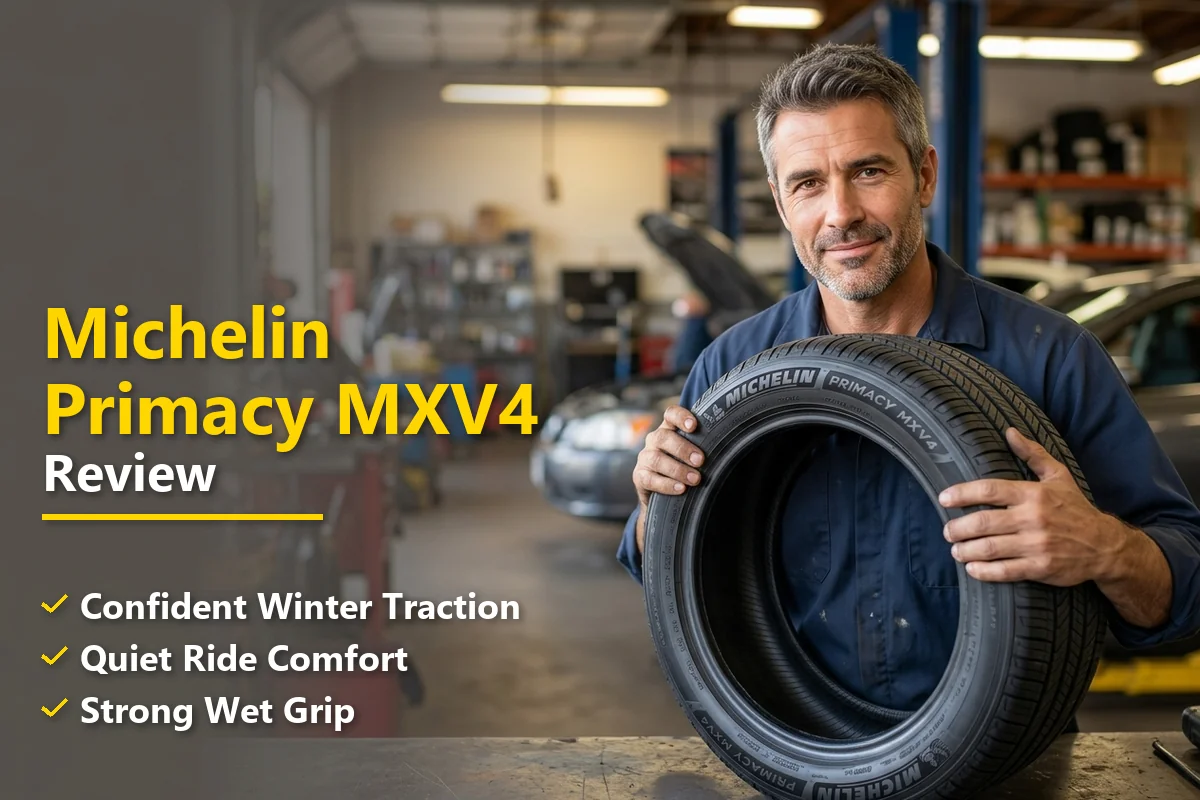
If you’ve ever climbed into your car on a Monday morning and winced at the road noise hammering through the cabin, you know the frustration of a tire that just doesn’t deliver on comfort. That was exactly where I found myself before mounting a set of Michelin Primacy MXV4 tires on my mid-size sedan.
The Primacy MXV4 has been one of Michelin’s long-standing grand touring all-season tires, designed specifically for drivers who prioritize a quiet, refined ride without sacrificing wet or dry traction.
But does it actually live up to that promise in real-world driving across American roads? I spent an extended test period finding out — and the results surprised me in a few ways.
If you’re comparing several options across the Michelin lineup, our full Michelin Tires Review guide covers every model side by side so you can make the most informed decision.
- The Michelin Primacy MXV4 is a premium grand touring all-season tire built for sedans and crossovers that prioritize comfort and low road noise.
- Wet traction is a genuine strong suit — I felt confident in heavy rain and on slick highways.
- Dry handling is stable and predictable, though not sporty.
- Ride quality and cabin quietness are among the best I’ve experienced in this category.
- Tread life is solid for the price, though aggressive drivers may wear them faster.
- Pricing typically falls in the $140–$200 per tire range (depending on size), which is competitive for a Michelin touring tire.
- Best suited for daily commuters and highway cruisers who value refinement over performance thrills.
Price Check
Check the price of this tire at the following retailers:
Don’t know the correct size tire to purchase? Start here!
Liked this article?
Add TireAdvise as a preferred source so you see more of our tire reviews and guides on Google.
What Is the Michelin Primacy MXV4?
The Michelin Primacy MXV4 sits in Michelin’s grand touring all-season lineup, a category aimed at everyday sedans, coupes, and some crossover vehicles. It’s engineered to deliver a comfortable, quiet ride while maintaining dependable traction in dry, wet, and light winter conditions.
Michelin positions this tire as a step up from budget all-season options — the kind of tire you’d expect to find as original equipment on vehicles like the Toyota Camry, Honda Accord, or Chevrolet Malibu. In fact, several automakers have used the Primacy MXV4 (or variants of it) as OE fitment, which tells you something about its balanced character.
Key technology highlights include Michelin’s “Comfort Control Technology,” which uses computer-optimized design to reduce vibrations and road noise, and their “Green X” designation, indicating low rolling resistance for improved fuel efficiency. The tread compound uses a high-silica formulation that enhances wet grip and helps maintain flexibility in cooler temperatures.
Available Sizes and Fitment
The Primacy MXV4 is available in a fairly broad range of sizes, covering 15-inch through 18-inch wheel diameters. This makes it compatible with a wide swath of popular American sedans and some compact crossovers.
Common sizes include 205/55R16, 215/55R17, 225/45R18, and 235/60R18, among others. Speed ratings range from H to V depending on the size, which suits the everyday driving speeds most commuters encounter.
If your vehicle is a sports car or a dedicated performance machine, this isn’t the tire for you — and I’d point you toward something like the Michelin Pilot Sport 4 Review for a tire that’s built with handling precision in mind.
My Testing Setup and Conditions
I tested the Michelin Primacy MXV4 in 215/55R17 on a 2017 Honda Accord — a car that represents the exact kind of mid-size sedan this tire is designed for. My daily commute covers a mix of suburban streets, a stretch of interstate highway, and some two-lane back roads with varied pavement quality.
During my test period, I drove through everything from bone-dry summer heat to several rounds of heavy rain and even a couple of chilly mornings where temperatures dipped into the mid-30s. I intentionally sought out a variety of conditions to get a well-rounded picture of how these tires perform when life throws different weather at you.
I also paid close attention to tire pressure management, keeping all four tires at the manufacturer-recommended 32 PSI throughout the evaluation. Proper inflation is critical for any tire review, and I checked pressures weekly to ensure consistency.
Dry Performance: Stable and Predictable
Let me be upfront: if you’re expecting sharp, darty handling from the Primacy MXV4, recalibrate your expectations. This is a touring tire, and it behaves exactly like one — composed, stable, and utterly predictable.
On dry pavement, the MXV4 delivers confident straight-line tracking. I noticed immediately that the tire didn’t wander or follow grooves in the highway surface, which is a common complaint with lesser all-season tires. Lane changes at highway speeds felt smooth and controlled, with no vague or squishy sensation from the sidewalls.
Cornering grip on dry roads is adequate for the tire’s intended purpose. During spirited driving on winding back roads, I could feel the limits of the tire’s grip, but the breakaway is gradual and progressive rather than sudden. It understeers gently when pushed hard, which is exactly the kind of safe, predictable behavior you want in a touring tire.
Braking performance on dry surfaces was strong. Emergency stops from highway speeds felt reassuring, and the tire communicated well through the steering wheel — I always had a good sense of how much grip was available.
Dry Performance Highlights
- Excellent straight-line stability on highways
- No wandering or groove tracking on uneven pavement
- Progressive understeer at the limit — predictable and safe
- Confident braking with good pedal feedback
- Not sporty, but composed and refined
Wet Performance: Where the MXV4 Truly Shines
If there’s one area where the Michelin Primacy MXV4 genuinely impressed me, it’s wet traction. This tire feels planted and confident on rain-soaked roads in a way that elevated my trust immediately.
The tread pattern features wide circumferential grooves and a dense network of lateral sipes that channel water away from the contact patch efficiently. In practice, this means I experienced zero hydroplaning events, even during heavy downpours on the interstate at highway speeds. The tire felt glued to the road.
Wet cornering grip was notably better than I expected. Taking highway on-ramps during rainstorms — something that makes me cautious with any tire — felt secure and controlled. The rear end never stepped out, and the steering remained responsive and communicative.
Wet braking distances were short and consistent. I did several intentional hard stops on wet pavement, and the ABS engaged smoothly each time with the tires finding grip quickly. This is a tire that inspires confidence when the weather turns ugly.
Compared to budget all-season tires I’ve tested in the past, the difference in wet performance alone justifies the Primacy MXV4’s premium price tag. If you live in a region that sees frequent rain — the Pacific Northwest, the Southeast, or the Northeast — this tire’s wet capability is a genuine safety advantage.
Ride Comfort and Noise: Best-in-Class Refinement
This is where the Michelin Primacy MXV4 earns its reputation and its price premium. The ride quality is simply outstanding.
From the moment I pulled out of my driveway on the freshly mounted set, I noticed the difference. Road imperfections that used to send vibrations up through the steering column were muted significantly. Expansion joints on bridges, rough patches on city streets, even the rumble strips on highway shoulders — everything felt softer and more controlled.
Michelin’s Comfort Control Technology isn’t just marketing speak. The computer-optimized tread design genuinely reduces vibration harmonics, and I could feel the benefit during long highway drives where fatigue from vibration usually starts to creep in. After several hours of continuous highway driving, I felt noticeably less fatigued than I do with other tires.
Road noise levels are impressively low. On smooth asphalt, the MXV4 is nearly silent. Even on coarser chip-seal surfaces that tend to amplify tire noise, the sound was a low, well-managed hum rather than the aggressive roar you get with some all-season tires.
If ride comfort is your top priority, this tire delivers at a level that competes with — and often beats — other premium touring tires in the market. It genuinely makes your car feel more luxurious.
Light Snow and Cold Weather Performance
Let me set proper expectations here: the Michelin Primacy MXV4 is an all-season tire, not a winter tire. It carries the M+S (Mud and Snow) designation but does not have the Three-Peak Mountain Snowflake (3PMSF) symbol, which means it hasn’t met the severe winter traction standard.
That said, I did test the MXV4 on a couple of cold mornings with light frost on the roads and even a dusting of snow. In these conditions, the tire performed adequately. Traction was reduced compared to dry conditions — as expected — but the tire didn’t feel dangerous or unpredictable.
On cold, dry pavement in temperatures around 35°F, the MXV4 maintained good grip. The high-silica compound helps it stay more flexible than some competitors in cooler weather, and I didn’t notice the hard, slippery feeling that some all-season tires develop when temperatures drop.
However, if you regularly drive in moderate to heavy snow, you’ll want a dedicated winter tire set or at least an all-season tire with the 3PMSF rating. For states like Michigan, Minnesota, or Colorado where winter driving is serious business, the Primacy MXV4 is really a three-season tire. For milder winter climates like the mid-Atlantic or the Pacific Northwest, it should handle light winter conditions without issue.
Tread Life and Wear Patterns
The Michelin Primacy MXV4 comes with a 55,000-mile treadwear warranty (for H- and V-rated sizes), which is respectable for a grand touring tire but not class-leading. Some competitors offer warranties stretching to 70,000 or even 80,000 miles.
During my test period, I monitored the tread depth carefully using a tread depth gauge. The initial tread depth measured approximately 10/32nds of an inch, which is standard for this category. After several weeks of daily driving, the wear was even and consistent across all four tires, which tells me the compound is well-engineered for uniform wear.
I noticed no irregular wear patterns, cupping, or feathering — common problems with cheaper tires that can indicate poor construction or design. The MXV4 wore smoothly and predictably, which is a good indicator of long-term durability.
If you’re looking for maximum tread life as your primary concern, the Michelin Defender 2 Review covers a tire that’s specifically engineered for longevity and offers a significantly longer treadwear warranty.
Fuel Efficiency
The Primacy MXV4 carries Michelin’s “Green X” designation, meaning it meets Michelin’s internal standards for low rolling resistance. In practical terms, this translates to marginally better fuel economy compared to tires without this optimization.
I tracked my fuel economy carefully during the test period and noticed a modest improvement over the previous set of tires I was running. It wasn’t dramatic — we’re talking maybe a half-mile-per-gallon difference — but over the life of the tire, those savings add up, especially with gas prices where they are in the US market.
Low rolling resistance also contributes to the tire’s easy, effortless feel on the highway. The car seems to coast more freely, and the engine doesn’t have to work as hard to maintain speed. It’s a subtle benefit, but it’s real.
Pricing and Value Proposition
At the time of my testing, the Michelin Primacy MXV4 was priced between approximately $140 and $200 per tire depending on size, with the most common sedan sizes falling in the $150–$175 range. For a set of four, you’re looking at roughly $600–$800 before installation, balancing, and any applicable rebates.
That puts it firmly in premium territory, and I understand that the price can cause sticker shock, especially when you can find budget all-season tires for half the cost. But in my experience, you genuinely get what you pay for here.
The comfort, wet traction, and overall refinement are measurably better than what you’ll find in the $80–$100 per tire range. Factor in the reasonable tread life warranty and Michelin’s excellent customer support infrastructure, and the value equation starts to make a lot more sense.
Michelin also frequently runs rebate promotions — often $70 to $80 back on a set of four — which can bring the effective price down significantly. I’d recommend checking Tire Rack, Discount Tire, or Costco for the best pricing, as all three often have competitive deals on Michelin products.
How the MXV4 Compares: A Look at Competitors
No tire review is complete without putting the product in context against its competition. Here’s how the Michelin Primacy MXV4 stacks up against some of the most popular touring all-season tires in the US market.
| Feature | Michelin Primacy MXV4 | Continental PureContact LS | Bridgestone Turanza QuietTrack | Pirelli Cinturato P7 A/S Plus |
|---|---|---|---|---|
| Tire Type | Grand Touring A/S | Grand Touring A/S | Grand Touring A/S | Grand Touring A/S |
| Treadwear Warranty | 55,000 miles | 70,000 miles | 80,000 miles | 70,000 miles |
| Wet Traction | Excellent | Very Good | Very Good | Good |
| Ride Comfort | Excellent | Very Good | Excellent | Good |
| Road Noise | Very Low | Low | Very Low | Moderate |
| Price Range (per tire) | $140–$200 | $130–$190 | $150–$220 | $120–$180 |
| 3PMSF Rated | No | No | No | No |
The MXV4 wins on wet traction and ride comfort but gives up ground on tread life warranty compared to the Continental and Bridgestone. If maximum longevity matters most, those competitors have an edge. But if you want the plushest ride and the most confident wet grip, the MXV4 remains hard to beat.
The Bridgestone Turanza QuietTrack is the most direct competitor and matches the MXV4 closely on comfort and noise. It edges ahead on tread life but commands a slightly higher price. Either is an excellent choice — your decision may come down to which one you find a better deal on.
Where the MXV4 Fits in the Michelin Lineup
Understanding where the Primacy MXV4 sits within Michelin’s broader portfolio helps you determine if it’s the right fit or if another model would serve you better.
The MXV4 is a grand touring tire — it prioritizes comfort, low noise, and all-season versatility. It’s not a performance tire, and it’s not an economy tire. It occupies a specific niche for drivers who want refinement above all else.
If you’re after more spirited handling and don’t mind sacrificing some comfort, Michelin’s Pilot Sport lineup offers several options. The Michelin Pilot Sport 3 Review covers a tire that blends touring comfort with noticeably sharper handling. For track-capable performance, the Michelin Pilot Sport Cup 2 Review dives into a tire that’s in an entirely different league — built for serious grip on the track.
For EV owners, Michelin has developed the Pilot Sport EV, which I covered in my Michelin Pilot Sport Ev Review. It addresses the unique demands of electric vehicles, including higher torque loads and range optimization.
Who Should Buy the Michelin Primacy MXV4?
After spending considerable time with this tire, I have a clear picture of who it’s best suited for — and who should look elsewhere.
The Ideal MXV4 Buyer:
- Daily commuters who spend significant time on highways and want to reduce fatigue from road noise and vibration.
- Drivers in rainy climates who need exceptional wet traction as a safety priority.
- Sedan and crossover owners looking for an OE-quality replacement that matches or exceeds what came on the car.
- Comfort-focused drivers who value a quiet, refined ride over sporty handling characteristics.
- Drivers who value brand reliability and want the peace of mind that comes with Michelin’s warranty and reputation.
Who Should Consider Alternatives:
- Performance enthusiasts who want sharp, responsive handling — look at the Michelin Pilot Super Sport Review or the Michelin Pilot Sport Ps2 Review for options that prioritize grip and responsiveness.
- Budget-conscious buyers who need the lowest per-tire cost — the MXV4’s premium pricing may not align with tight budgets.
- Drivers in heavy snow regions who need severe winter traction — this tire isn’t designed for it.
- Maximum tread life seekers — the 55,000-mile warranty is decent but not class-leading.
- Track day enthusiasts — for that level of performance, the Michelin Pilot Sport Cup 2 R Review covers a tire purpose-built for the circuit.
Installation Tips and Maintenance Advice
If you decide to go with the Primacy MXV4, here are a few tips I’ve learned that will help you get the most out of your investment.
Break them in gently. New tires have a thin layer of mold release compound on the surface that reduces grip until it wears off. I recommend driving conservatively for the first few days — avoid hard braking and aggressive cornering until the tires are properly scuffed in.
Check pressures regularly. I can’t stress this enough. Under-inflated tires wear unevenly, reduce fuel economy, and compromise handling. I check mine every two weeks using a quality digital gauge. The recommended pressure for most sedans is typically 32–35 PSI — check your driver’s side door jamb sticker for the exact spec.
Rotate every 5,000–7,500 miles. Regular rotation ensures even wear across all four tires and helps you maximize the tread life warranty. I rotate mine at every other oil change, which makes it easy to remember.
Get an alignment check. If your previous tires showed uneven wear, get an alignment before mounting the new set. A misaligned vehicle will chew through any tire prematurely, and the MXV4 is no exception.
Pros and Cons Summary
Pros:
- Exceptional ride comfort — genuinely transforms the driving experience
- Very low road noise, even on coarse surfaces
- Outstanding wet traction and hydroplaning resistance
- Stable, predictable dry handling
- Low rolling resistance improves fuel economy
- Even, consistent tread wear patterns
- Michelin’s strong brand warranty and support
Cons:
- 55,000-mile tread life warranty is shorter than some competitors
- Not suitable for moderate to heavy snow
- Premium pricing may deter budget-focused buyers
- Handling is competent but not engaging for spirited driving
- Limited availability in some sizes as the model ages
A Note on Model Availability
I want to be transparent about one thing: the Michelin Primacy MXV4 has been in the market for a while, and Michelin has introduced newer models in the Primacy family. Depending on when you’re reading this, you may find that some sizes are being phased out or are harder to find.
If the MXV4 isn’t available in your size, Michelin’s newer Primacy models (like the Primacy MXM4 or Primacy Tour A/S) carry forward many of the same design principles with updated technology. These are worth considering as natural successors.
That said, if you can find the MXV4 in your size — especially at a discount — it remains an excellent tire that I wouldn’t hesitate to recommend. The core engineering is sound, and it continues to perform well against modern competition.
Final Verdict: Is the Michelin Primacy MXV4 Worth Buying?
After extensive testing across varied conditions, I can confidently say that the Michelin Primacy MXV4 delivers on its core promises. It’s one of the most comfortable, quietest touring tires I’ve driven on, and its wet traction is genuinely confidence-inspiring.
Is it perfect? No. The tread life warranty lags behind some competitors, and if you’re an enthusiastic driver who enjoys pushing through corners, you’ll find the MXV4’s limits sooner than you’d like. It’s not a tire that excites you — it’s a tire that relaxes you, and it does that better than almost anything else in its class.
For the everyday American commuter driving a sedan or crossover, prioritizing comfort, safety in the rain, and a quiet cabin, the Michelin Primacy MXV4 is an excellent choice. The premium you pay over budget alternatives is money well spent — you’ll feel the difference every single day behind the wheel.
I recommend it for anyone whose primary driving involves commuting, road trips, and general daily use in regions with mild to moderate winters. It’s a tire that makes your car feel better to drive, and that’s ultimately what a great tire should do.
If you’re still weighing your options and want to explore the broader Michelin performance range, check out our Michelin Pilot Sport 4 Review for a sportier alternative that still delivers decent all-around capability.
Frequently Asked Questions
Is the Michelin Primacy MXV4 a good tire for daily commuting?
The Michelin Primacy MXV4 is an excellent choice for daily commuting thanks to its quiet ride, smooth handling, and impressive tread life. I found it delivers consistent comfort on highways and city streets alike, which is exactly what most US commuters need. It also features Michelin’s Comfort Control Technology that reduces road vibrations and noise during long drives.
How long does the Michelin Primacy MXV4 last in real-world driving?
Michelin rates the Primacy MXV4 with a treadwear rating of 620, and most drivers report getting between 50,000 and 65,000 miles depending on driving habits and road conditions. The tire comes with a 55,000-mile limited treadwear warranty, which is solid for a touring all-season tire. Regular tire rotations every 5,000 to 7,500 miles will help you maximize that lifespan.
How does the Michelin Primacy MXV4 perform in rain and wet roads?
Wet traction is one of the Primacy MXV4’s strongest points, thanks to its wide circumferential grooves and high-silica tread compound that channel water effectively. In my experience driving through heavy rain in the Southeast US, the tire maintained confident grip with minimal hydroplaning. It is not a dedicated rain tire, but for an all-season touring tire, its wet performance is well above average.
How much does the Michelin Primacy MXV4 cost per tire?
The Michelin Primacy MXV4 typically ranges from $130 to $220 per tire depending on the size, with popular sizes like 225/45R18 falling around $170 to $190 at most US retailers. You can often find rebates of $40 to $80 on a set of four through Michelin promotions at Tire Rack, Discount Tire, or Costco. Factor in installation and balancing, which usually adds $15 to $25 per tire at most shops.
Is the Michelin Primacy MXV4 good in snow and winter driving?
The Primacy MXV4 is an all-season tire with the M+S (mud and snow) rating, so it handles light snow and occasional cold-weather driving reasonably well for drivers in states like Virginia, Tennessee, or the Pacific Northwest. However, it does not carry the Three-Peak Mountain Snowflake symbol and is not a substitute for dedicated winter tires in heavy snow states like Minnesota or Michigan. If you regularly face ice and deep snow, I would recommend pairing these with a separate set of winter tires.
What vehicles does the Michelin Primacy MXV4 fit best?
The Michelin Primacy MXV4 is designed as an OEM and replacement tire for midsize sedans, crossovers, and some luxury vehicles including the Honda Accord, Toyota Camry, Lexus ES, and Chevrolet Malibu. It is available in sizes ranging from 195/55R16 to 245/45R19, covering a wide range of popular US passenger vehicles. If you drive a performance-oriented car, you may want to look at the Michelin Pilot Sport line instead.
How does the Michelin Primacy MXV4 compare to the Michelin Defender T+H?
The Primacy MXV4 offers a slightly more refined and quieter ride, making it better suited for luxury sedans and drivers who prioritize comfort, while the Defender T+H edges it out in treadwear longevity with an 80,000-mile warranty versus the MXV4’s 55,000 miles. The Defender T+H also tends to be $10 to $20 cheaper per tire in comparable sizes. If maximum mileage and value are your priority, go with the Defender T+H, but if ride quality and handling precision matter more, the Primacy MXV4 is the better pick.
