

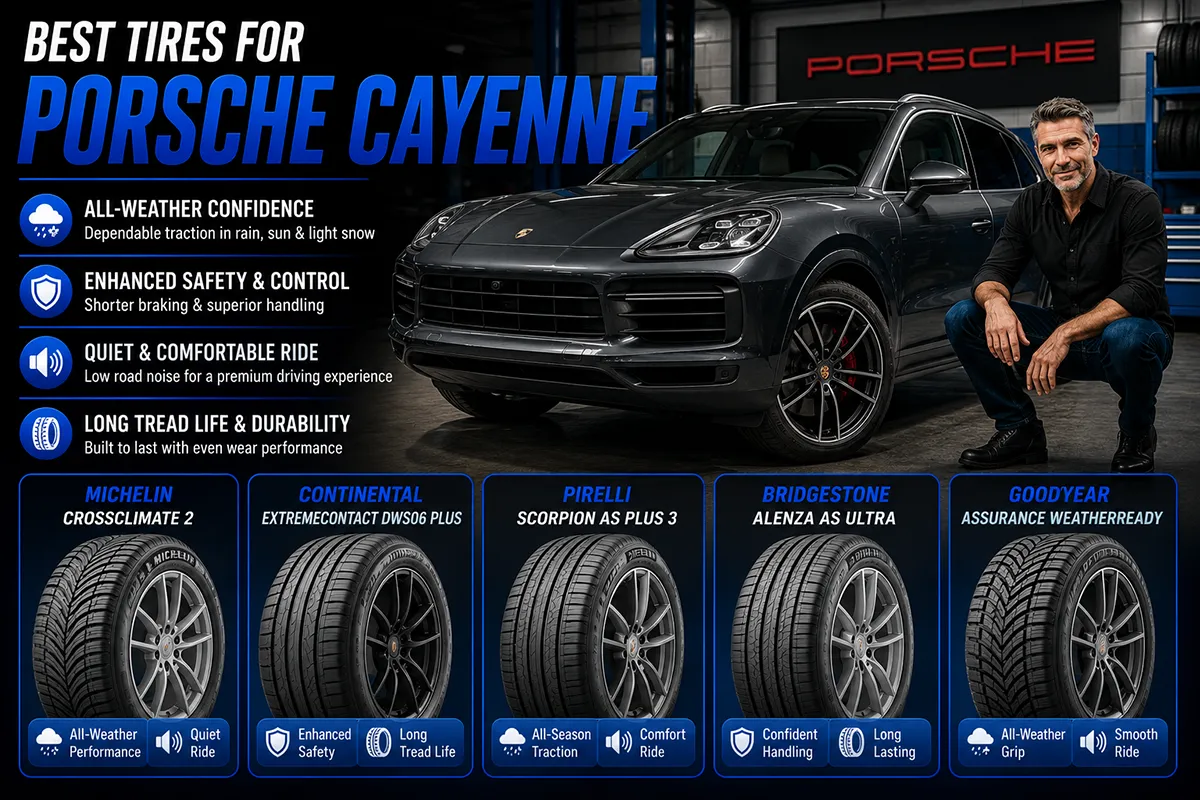
The Cayenne lineup runs from a 348-horsepower base V6 to a 729-horsepower Turbo E-Hybrid, and most trims run different tire sizes front to rear — two details that change what “best tire” actually means depending on which Cayenne you drive. This guide is built from manufacturer specifications, aggregated owner data, and independent test results, weighted specifically toward matching each tire to how Cayenne owners in each trim actually drive. Here’s what actually holds up, by priority.
- Best overall performance: Michelin Pilot Sport 4 SUV.
- Best handling and grip: Continental ExtremeContact Sport.
- Best luxury/OE option: Pirelli P Zero PZ4.
- Best all-season: Bridgestone Alenza A/S Ultra.
- Best high-performance value: Goodyear Eagle F1 Asymmetric 5.
- Best premium all-season: Michelin Pilot Sport All Season 4.
- Best for E-Hybrid models: Continental CrossContact LX25.
- Best dedicated winter: Pirelli Scorpion Winter.
- Full sizing by current trim, a staggered-fitment explainer, N-spec tires explained, and a recalls check are below.
Liked this article?
Add TireAdvise as a preferred source so you see more of our tire reviews and guides on Google.
How These Were Evaluated
This comparison draws on manufacturer specifications, aggregated owner reports, UTQG ratings, and independent traction and braking testing data for each tire, cross-referenced against the Cayenne’s real factory sizing across its current trims.
Particular weight was given to how each tire’s real-world character matches a specific Cayenne configuration — a base or E-Hybrid model used mostly for daily driving has different priorities than a GTS or Turbo E-Hybrid driven with real intent, and the added weight of the plug-in hybrid trims changes what a tire needs to deliver structurally.
Where specific tread-life figures, warranty numbers, or independently reported comparisons are cited, the source is noted rather than presented as a personal measurement.
Quick Comparison: 11 Best Tires for the Porsche Cayenne
| Tire | Best For | Approx. Price/Tire | 3PMSF Rated | Warranty |
|---|---|---|---|---|
| Michelin Pilot Sport 4 SUV | Best overall performance | $250–$350 | No | Not specified |
| Continental ExtremeContact Sport | Handling and grip | $230–$320 | No | Not specified |
| Pirelli P Zero PZ4 | Luxury/OE option | $260–$370 | No | Not specified |
| Bridgestone Alenza A/S Ultra | All-season | $195–$275 | Yes | 80,000 mi |
| Goodyear Eagle F1 Asymmetric 5 | High-performance value | $210–$290 | No | Not specified |
| Michelin Pilot Sport All Season 4 | Premium all-season | $260–$350 | No | 45,000–50,000 mi |
| Yokohama ADVAN Sport A/S+ | Balanced performance/comfort | $220–$300 | No | Not specified |
| Pirelli Scorpion Winter | Dedicated winter | $240–$330 | Yes | Seasonal (no summer warranty) |
| Continental CrossContact LX25 | E-Hybrid models | $175–$230 | No | 70,000 mi |
| Hankook Ventus S1 Evo3 SUV | Value performance | $185–$260 | No | Not specified |
| Michelin CrossClimate2 | All-weather, no seasonal swap | $220–$290 | Yes | 60,000–85,000 mi (size dependent) |
Prices are street prices at major online retailers for common Cayenne sizes as of mid-2026 — because most Cayenne trims run staggered fitment, front and rear tires are frequently different sizes and prices, so budget for both when pricing a full set.
Porsche Cayenne Tire Sizes, Staggered Fitment, and the Current Lineup
Confirm the exact size on the driver’s door jamb sticker before ordering — and understand two things most competing guides skip entirely: the Cayenne’s current trim structure changed recently, and most trims run genuinely different front and rear tire sizes.
The current lineup has changed. Porsche discontinued the non-hybrid Cayenne Turbo; the Turbo E-Hybrid (729 hp combined) now sits at the top of the regular lineup, and the Turbo GT is not a standard trim at all — it’s an extremely limited-production, track-focused model built around the Coupe body style, not something most shoppers will be cross-referencing tire guides for. The core 2026 lineup is Cayenne (base V6), E-Hybrid, S, S E-Hybrid, GTS, and Turbo E-Hybrid, with a separate but related Cayenne Electric line (base, S, and Turbo Electric) now also on sale. Several competing guides — and an earlier version of this one — still reference the old gas-only Turbo as a current trim; it isn’t.
Staggered fitment is the norm, not the exception. On base, E-Hybrid, S, S E-Hybrid, and GTS trims, the standard setup runs 255/55R20 front and 295/45R20 rear — a genuinely different size on each axle, not a typo. The Turbo E-Hybrid steps up to 285/45R21 front and 315/40R21 rear standard, with 285/40R22 front and 315/35R22 rear available as an option. This matters practically: staggered fitment means you cannot rotate tires front-to-back, only side-to-side on the same axle, and it means a “full set” replacement is really two different tire purchases in two different sizes — a detail worth knowing before you call around for pricing.
Understanding Porsche-Approved N-Specification Tires
Porsche owners will notice certain tires bearing N-specification markings (N0, N1, N2, N3, and so on) on the sidewall. These indicate tires Porsche has specifically tested and approved for a given Cayenne model — each number represents a generation or revision of that approval, not a ranking of quality. N-spec tires are co-developed with Porsche’s engineering team to match the Cayenne’s specific suspension tuning, stability control calibration, and handling characteristics.
You are not required to run N-spec tires on your Cayenne, and plenty of owners run non-N-spec replacements without issue.
The practical trade-off: N-spec tires are tuned specifically for your exact Cayenne, which can mean a more precisely matched driving feel, while non-N-spec alternatives from the same tire line often cost less and may prioritize slightly different characteristics like comfort or tread life.
Neither choice voids your factory warranty on its own — tire choice and mechanical warranty coverage are generally separate — but confirm with your specific dealer if you have concerns.
1. Michelin Pilot Sport 4 SUV: Best Overall Performance
Price Check
Check the price of this tire at the following retailers:
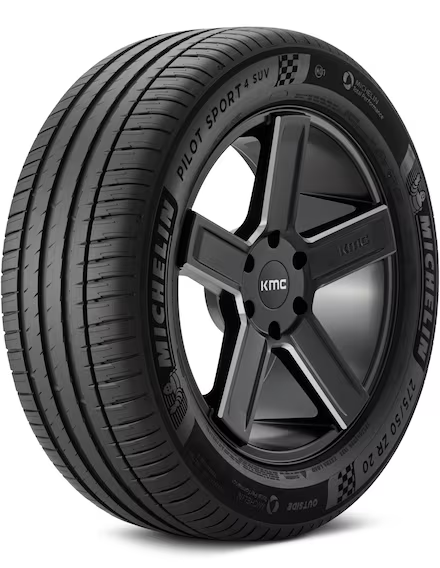
This tire delivers a genuinely strong balance for Cayenne owners who want to actually use the vehicle’s performance envelope. Michelin’s Dynamic Response Technology uses a hybrid aramid-and-nylon belt structure to maintain shape under hard cornering and braking, translating to precise, confidence-inspiring steering response that suits the Cayenne’s sporty chassis tuning.
The asymmetric tread pattern with rigid outer shoulders delivers genuine cornering stability, and a silica-infused compound provides confident grip in both dry and wet conditions, with wide grooves and deep lateral cuts that meaningfully reduce hydroplaning risk.
Michelin’s EverGrip Technology reveals new rain grooves as the tire wears, helping maintain wet performance later in the tire’s life — real owner reports commonly cite 30,000–40,000 miles of tread life with proper rotation, respectable for a genuine performance tire.
Acoustic foam technology also keeps cabin noise well-controlled despite the aggressive performance character. For base, S, and GTS owners who want their tires to match the Cayenne’s actual capability, this is the strongest overall pick.
Pros: Genuine cornering precision and wet-weather grip, respectable tread life for a performance tire, well-controlled cabin noise.
Cons: Premium price, tread life shorter than comfort-oriented alternatives, not built for winter conditions.
2. Continental ExtremeContact Sport: Best Handling and Grip

Price Check
Check the price of this tire at the following retailers:
For Cayenne owners who prioritize dynamic handling and direct feedback, the ExtremeContact Sport delivers genuinely stable cornering through Continental’s SportPlus Technology, which maintains contact-patch consistency during aggressive maneuvers. The reinforced sidewall construction reduces flex during hard cornering, maintaining tire geometry for consistent performance lap after lap or curve after curve.
Independent testing shows braking distances that genuinely rival dedicated summer tires, and the silica-enhanced compound maintains grip under heavy braking — a real safety margin given the Cayenne’s substantial weight and power.
High-speed stability is a genuine strength here too, with minimal tread squirm well beyond posted limits, making this a strong pick for GTS and Turbo E-Hybrid owners who occasionally push the car or drive extended stretches at speed.
Pros: Genuine braking performance rivaling summer tires, strong high-speed stability, direct road feedback without excessive harshness.
Cons: Premium price, tread life shorter than touring-oriented options, not built for winter conditions.
3. Pirelli P Zero PZ4: Best Luxury/OE Option
Price Check
Check the price of this tire at the following retailers:
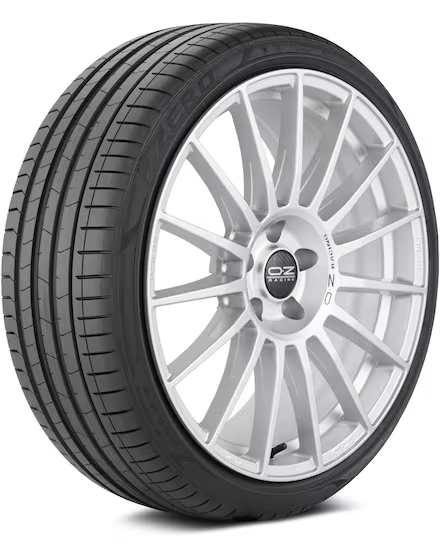
The P Zero PZ4 has a genuine claim to authenticity for Cayenne owners: it’s one of the tires Porsche co-developed directly with Pirelli, and it’s commonly found carrying N-specification markings on Cayenne factory fitments. The asymmetric tread pattern with larger outer blocks provides real cornering stability at higher speeds, and a functional-polymer compound maintains grip in both dry and wet conditions.
One genuine differentiator worth knowing about: Pirelli also produces a PZ4 Elect variant, engineered specifically for heavier electric and plug-in hybrid vehicles, with reinforced construction and added noise-reduction technology to handle the extra mass and torque of hybrid drivetrains — worth asking about specifically if you’re shopping for an E-Hybrid or S E-Hybrid model.
Pirelli’s Noise Cancelling System (PNCS), a sound-absorbing layer applied to the inner tire wall, is available across the PZ4 range and genuinely reduces cabin noise, complementing the Cayenne’s luxury positioning. Select variants also include SealInside technology, allowing the tire to maintain air pressure after small punctures.
Pros: Genuine OE pedigree and N-spec availability, real noise-reduction technology, a hybrid-specific Elect variant for heavier trims.
Cons: Premium pricing, tread life not class-leading, not built for winter conditions.
4. Bridgestone Alenza A/S Ultra: Best All-Season
Price Check
Check the price of this tire at the following retailers:
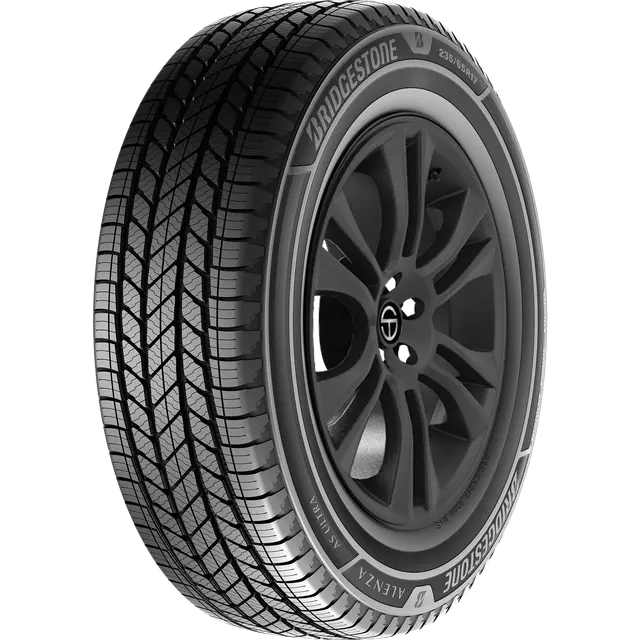
This tire delivers genuinely consistent performance across seasons for Cayenne owners who want one set of tires rather than a seasonal swap. Bridgestone built the Alenza A/S Ultra specifically for SUVs and crossovers where a quiet, luxurious ride matters alongside real all-season capability, and a silica-enriched compound stays responsive as temperatures shift without the softening that compromises handling in lesser all-season tires.
Four wide circumferential grooves genuinely reduce hydroplaning risk in wet conditions, and 3D sipes provide real biting-edge traction on slick surfaces. The tire carries 3PMSF certification, meaning it’s passed the standardized severe-snow traction test — genuinely useful for Cayenne owners in milder winter regions who don’t want a dedicated winter tire but still want honest snow capability.
Bridgestone backs the Alenza A/S Ultra with a genuinely strong 80,000-mile warranty, among the best in this comparison. For Cayenne owners prioritizing comfort and year-round versatility, this is the strongest all-season pick.
Pros: Genuine 3PMSF-rated all-season versatility, strong 80,000-mile warranty, quiet and comfortable ride.
Cons: Not built for aggressive performance driving, doesn’t match a dedicated winter tire in severe conditions.
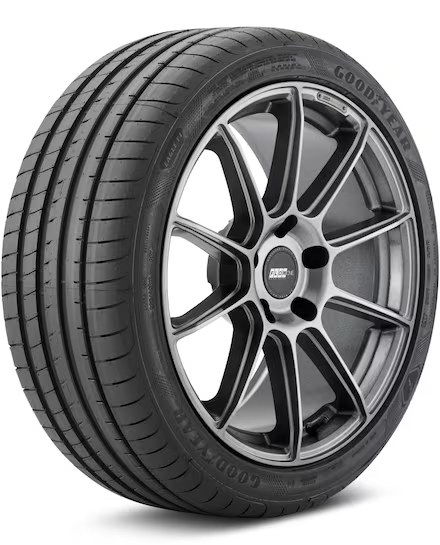
5. Goodyear Eagle F1 Asymmetric 5: Best High-Performance Value
Price Check
Check the price of this tire at the following retailers:
This tire delivers genuinely strong performance metrics at a more accessible price than the ultra-premium options in this comparison. Goodyear’s active braking grip technology uses an adaptive contact patch that physically responds during braking, resulting in real, measurably shorter wet stopping distances — a meaningful safety margin for a vehicle with the Cayenne’s weight and power.
The reinforced construction maintains genuine steering feedback for confident cornering, and Goodyear’s noise-dampening tread pattern keeps cabin noise well-controlled despite the performance-oriented design. For Cayenne owners who want to maintain the vehicle’s handling character without paying flagship pricing, this is a strong, credible value pick.
Pros: Genuine performance at a more accessible price point, strong wet braking, well-controlled road noise.
Cons: Doesn’t quite match the outright grip of the Pilot Sport 4 SUV or ExtremeContact Sport, not built for winter conditions.
6. Michelin Pilot Sport All Season 4: Best Premium All-Season

Price Check
Check the price of this tire at the following retailers:
Michelin’s flagship all-season performance tire genuinely closes the gap between summer-tire grip and year-round versatility better than most competitors attempt. Helio+ Technology, incorporating sunflower oil and extreme silica, keeps the compound pliable in cold conditions while maintaining structural integrity in summer heat — a real engineering solution to the usual all-season compromise.
Light snow performance is a genuine strength here, with 360-degree Variable Sipe Technology creating real biting edges on snow-covered roads, while rigid outer shoulder blocks and continuous center ribs deliver dry-condition cornering that feels closer to a dedicated summer tire than most all-season options.
MaxTouch Construction distributes forces evenly across acceleration, braking, and cornering, resulting in genuinely competitive tread life for the performance-all-season category. For Cayenne owners who want one tire covering spirited summer drives through winter commutes, this is the strongest pick — with the caveat that severe winter conditions still call for a dedicated winter tire.
Pros: Genuine summer-tire-like dry grip in an all-season package, real light-snow capability, competitive tread life for the category.
Cons: Premium price, doesn’t replace a dedicated winter tire in severe conditions.
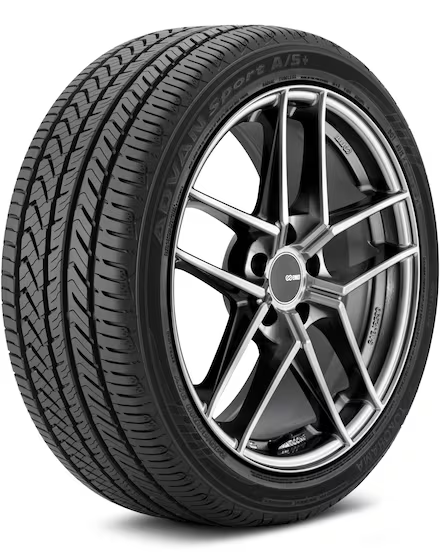
7. Yokohama ADVAN Sport A/S+: Best Balanced Performance and Comfort
Price Check
Check the price of this tire at the following retailers:
For Cayenne owners who want genuine performance character without sacrificing daily-driving comfort, the ADVAN Sport A/S+ strikes a real middle ground. An adaptive tread compound stays responsive in cold temperatures while maintaining stability in heat, and Yokohama’s optimized pitch sequencing genuinely reduces the harmonic road noise that plagues many performance tires.
A two-ply sidewall construction absorbs road imperfections before they transmit to the suspension, delivering a noticeably smoother ride that complements the Cayenne’s refined character. Handling remains predictable and confident, if not quite as razor-sharp as the outright performance leaders in this comparison, with stiffer shoulder blocks maintaining shape during aggressive cornering. For Cayenne owners who split time between daily comfort and weekend performance driving, this is a well-rounded pick.
Pros: Genuine comfort-performance balance, noticeably quiet for a performance-oriented tire, predictable cornering feedback.
Cons: Not as sharp at the limit as dedicated performance options, not built for winter conditions.
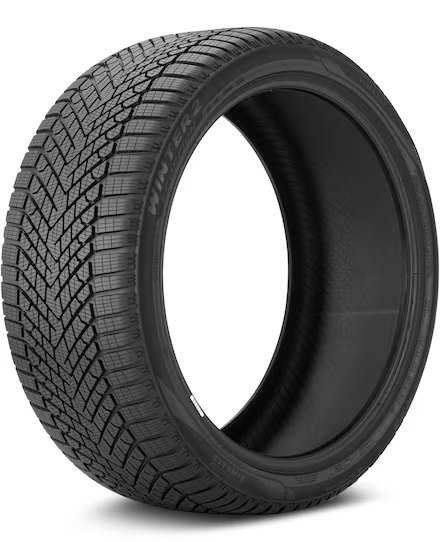
8. Pirelli Scorpion Winter: Best Dedicated Winter
Price Check
Check the price of this tire at the following retailers:
Nothing in this comparison matches this tire once conditions turn to genuine ice and snow. Pirelli built the Scorpion Winter specifically for high-performance SUVs, with a cold-weather compound that stays pliable well below the 45°F threshold where standard tires begin to harden and lose grip — a real, meaningful difference in cold-weather traction.
A directional tread pattern with wide longitudinal grooves channels away slush and water, and a dense sipe network creates genuine biting-edge grip on snow and ice. Despite its winter specialization, the tire’s reinforced structure keeps the Cayenne’s steering response predictable rather than vague, and independent testing shows meaningfully shorter braking distances on snow and ice compared to standard all-season tires. This is a seasonal tire that needs to come off once temperatures consistently rise above 45°F. For Cayenne owners in regions with real, sustained winter conditions, running this on a second set of wheels is the single biggest safety upgrade available.
Pros: Best-in-comparison ice and snow traction, genuine handling composure for a winter-specific tire.
Cons: Seasonal use only, no summer tread warranty, doesn’t match performance tires in warm-weather grip.
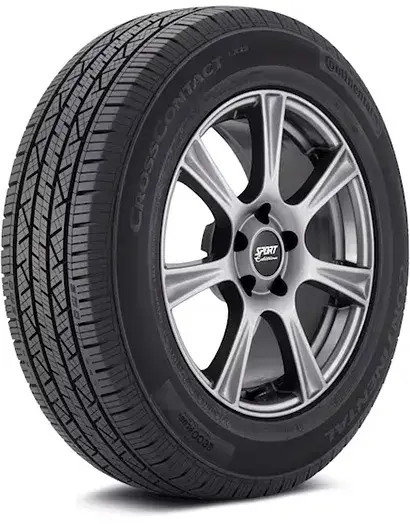
9. Continental CrossContact LX25: Best for E-Hybrid Models
Price Check
Check the price of this tire at the following retailers:
For Cayenne E-Hybrid and S E-Hybrid owners, rolling resistance genuinely matters to real-world electric range and fuel economy, and the CrossContact LX25 is built around exactly that priority. Continental’s EcoPlus Technology uses a specialized silica compound that measurably reduces the energy lost as the tire rolls, translating to real efficiency gains for a hybrid drivetrain.
Continental’s ComfortRide Technology genuinely reduces road noise and vibration, complementing the E-Hybrid’s already quiet electric-drive character, and DuraGen Technology — twin steel belts reinforced with spirally wrapped nylon — addresses the added structural demands of the hybrid battery’s extra weight. A temperature-activated compound adapts to conditions, staying pliable when cold and stable when warm. Continental backs the LX25 with a strong 70,000-mile warranty. For E-Hybrid Cayenne owners who prioritize efficiency without abandoning Porsche’s driving character, this is the most balanced option in this comparison.
Pros: Genuine efficiency benefit for hybrid drivetrains, strong 70,000-mile warranty, reinforced construction for hybrid weight.
Cons: Not built for aggressive performance driving, no 3PMSF rating.
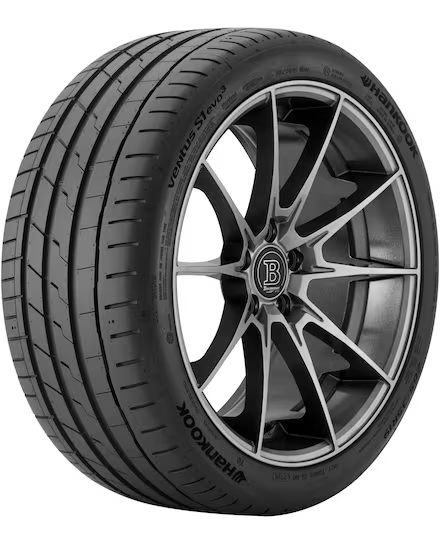
10. Hankook Ventus S1 Evo3 SUV: Best Value Performance
Price Check
Check the price of this tire at the following retailers:
This tire has earned a genuine following among Cayenne owners as a credible alternative to more established premium brands, typically priced 15–20% below comparable options. Hankook’s silica-enriched compound maintains flexibility across a wide temperature range while delivering real tread life, and an asymmetric tread pattern with optimized block stiffness provides precise steering response that suits the Cayenne’s sporty character.
Wet performance is a genuine strength: wide circumferential grooves and an intricate lateral-channel network deliver real hydroplaning resistance and confident wet traction, with predictable feedback during emergency maneuvers. Real owner reports commonly describe pleasantly refined road manners and well-controlled noise for a performance-oriented tire. For Cayenne owners who want genuine performance character without premium-brand pricing, this is the strongest value pick.
Pros: Genuine value relative to premium alternatives, strong wet-weather performance, refined road manners.
Cons: Less established track record than premium competitors, not built for winter conditions.
11. Michelin CrossClimate2: Best All-Weather, No Seasonal Swap

Price Check
Check the price of this tire at the following retailers:
For Cayenne owners who don’t want to swap tires seasonally but face real winter weather often enough that a standard all-season tire feels risky, the CrossClimate2 offers a genuine middle path. It carries 3PMSF certification and delivers significantly better cold-weather performance than a typical all-season tire, without the seasonal changeover a dedicated winter tire like the Scorpion Winter requires.
Its V-shaped tread with dense biting edges maintains solid traction in light to moderate snow while still delivering respectable dry-weather handling — genuinely more capable in winter conditions than the Pilot Sport All Season 4, though it trades away some of that tire’s outright dry-weather sharpness in return.
Warranty coverage varies meaningfully by size, so confirm the specific figure for your Cayenne’s exact fitment. For base, E-Hybrid, and S owners in regions with moderate but real winters who want one set of tires year-round, this is the strongest single-tire solution in this comparison.
Pros: Genuine 3PMSF-rated winter capability without seasonal swapping, respectable dry handling, wide size availability.
Cons: Doesn’t match a dedicated winter tire on ice, less sharp than dedicated performance or performance-all-season options.
Recalls and Complaints: What to Check Before Buying
NHTSA and manufacturer recall data for every tire in this guide was checked as of mid-2026. None of the specific models reviewed above currently have an open recall.
One Cayenne-specific note genuinely worth knowing: a 2022 recall (NHTSA campaign 22V-040) affected certain 2021–2022 Cayenne vehicles where a rear axle alignment issue, stemming from an earlier suspension recall, could cause premature or uneven tire wear — Porsche’s remedy included replacing any prematurely worn tires found during the inspection.
This is a good, specific reminder that misalignment can silently damage tires even outside a recall context, and it’s worth an alignment check if you own an affected model year and haven’t had the axle inspected.
Before installing any tire, new or used, check the DOT code against NHTSA’s recall database — it takes about thirty seconds and is the single easiest safety check most people skip.
Maintaining Cayenne Tires
Rotate every 5,000 to 7,000 miles — but remember that staggered fitment on most Cayenne trims limits rotation to side-to-side on the same axle rather than the front-to-back patterns used on non-staggered vehicles.
Check pressure at least monthly, typically 35–40 PSI depending on model, but always confirm against the door jamb sticker rather than the maximum pressure printed on the tire sidewall. Pressure changes roughly 1 PSI for every 10°F temperature swing.
Have alignment checked annually, or sooner after hitting a significant pothole or curb — the Cayenne’s performance-tuned suspension demands precise alignment, and as the 2022 recall demonstrated, misalignment can cause real, accelerated tire wear even without an obvious symptom.
Watch for genuine replacement signs: tread depth below 4/32″ (consider replacement closer to this threshold than the legal 2/32″ minimum given the Cayenne’s performance and weight), uneven wear on one edge, visible sidewall cracks or bulges, or decreased wet-weather performance.
Choosing the Right Tire for a Porsche Cayenne
Match tire category to the specific trim and how it’s actually driven. Base, S, and GTS owners get real, felt value from the Michelin Pilot Sport 4 SUV or Continental ExtremeContact Sport’s genuine handling precision; E-Hybrid and S E-Hybrid owners benefit specifically from the Continental CrossContact LX25’s efficiency focus or the Pirelli PZ4 Elect variant built for hybrid weight and torque.
Don’t skip winter tires facing real cold. The Pirelli Scorpion Winter delivers a genuine, safety-relevant traction advantage no all-season or all-weather tire in this comparison fully replicates once conditions turn to sustained ice.
Remember staggered fitment when budgeting and rotating. Most Cayenne trims run different front and rear sizes — plan for two tire prices, not one, and know that side-to-side rotation is your only option.
N-spec tires aren’t mandatory, but they’re a genuine, defensible choice. If you want the tire tuned specifically to your exact Cayenne’s suspension and stability-control calibration, look for the N-marking that matches your model; if comfort, tread life, or price matter more, a non-N-spec alternative from the same tire line is a reasonable trade.
Frequently Asked Questions
What size tires does my Porsche Cayenne need?
It depends on trim, and most Cayenne trims run staggered fitment — different sizes front and rear. Base, E-Hybrid, S, S E-Hybrid, and GTS trims commonly run 255/55R20 front and 295/45R20 rear, while the Turbo E-Hybrid runs 285/45R21 front and 315/40R21 rear standard. Always check the door jamb sticker for the exact specification.
How often should I rotate the tires on my Porsche Cayenne?
Every 5,000 to 7,000 miles. Because most Cayenne trims run staggered front/rear sizing, rotation is limited to side-to-side on the same axle rather than front-to-back.
Has Porsche changed the Cayenne lineup recently?
Yes. The non-hybrid Cayenne Turbo has been discontinued and replaced by the Turbo E-Hybrid as the range-topping regular trim. The Turbo GT is not a standard trim — it’s an extremely limited-production, track-focused model built on the Coupe body style. The current core lineup is Cayenne, E-Hybrid, S, S E-Hybrid, GTS, and Turbo E-Hybrid, alongside the newer Cayenne Electric line.
Do I need N-specification tires for my Porsche Cayenne?
No. N-spec tires are Porsche-approved and tuned specifically for your exact Cayenne model, which can mean a more precisely matched driving feel, but non-N-spec alternatives from the same tire lines are widely used without issue and don’t inherently void your vehicle warranty.
Are all-season tires good enough for winter driving in my Porsche Cayenne?
All-season and all-weather tires handle light to moderate snow adequately, but for severe winter conditions with regular snowfall or temperatures consistently below 45°F, a dedicated winter tire like the Pirelli Scorpion Winter delivers meaningfully better traction and safety.
What’s the best tire for a Porsche Cayenne E-Hybrid?
The Continental CrossContact LX25 is built specifically around low rolling resistance, genuinely benefiting hybrid efficiency and range, while Pirelli’s PZ4 Elect variant offers a more performance-oriented option reinforced for hybrid vehicle weight.
How do I know when it’s time to replace my Porsche Cayenne’s tires?
Watch for tread depth below 4/32 of an inch (the penny test works as a quick check, though 4/32″ is a better replacement point than the legal 2/32″ minimum for a performance vehicle), uneven wear patterns, visible sidewall cracks or bulges, excessive vibration while driving, or decreased performance in wet conditions.
