

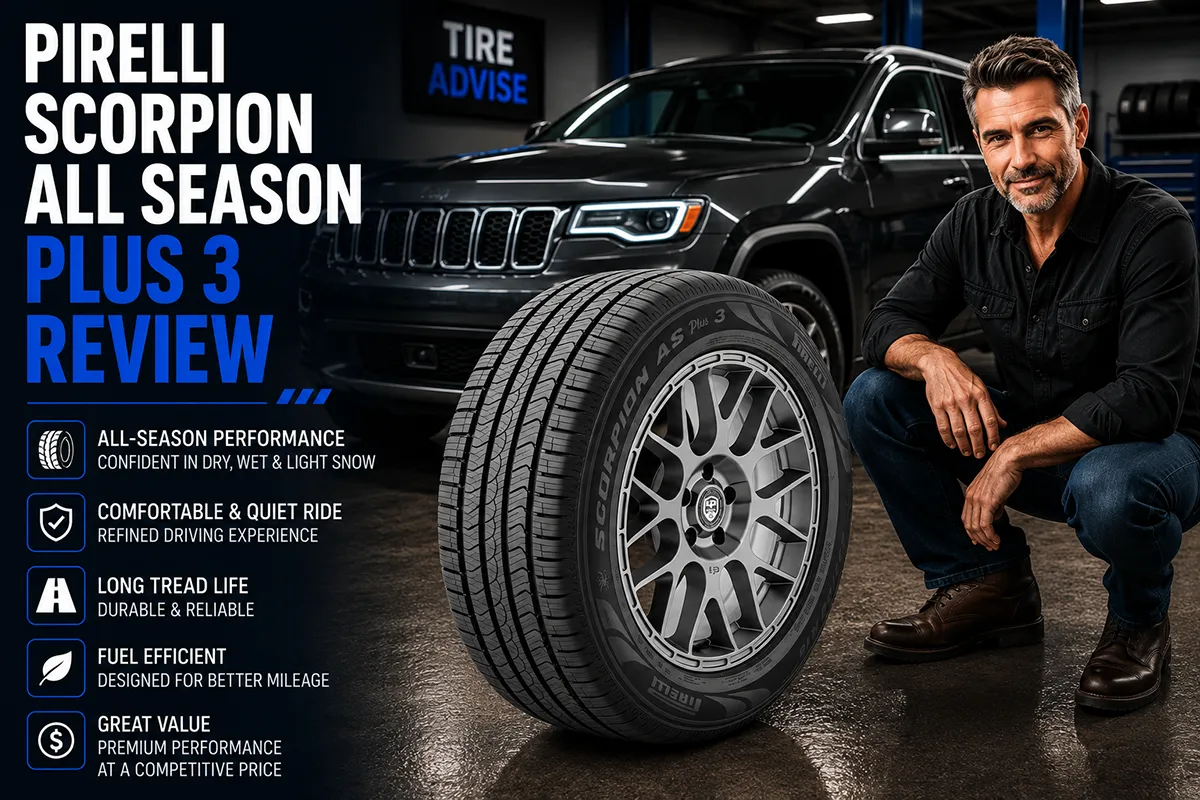
I mounted a set of Pirelli Scorpion All Season Plus 3 tires on my Toyota Highlander after wearing out a set of Yokohama OE rubber, and I’ve now put them through a Front Range hailstorm, gravel forest roads, and a January cold snap to see if the numbers on paper actually hold up on real roads.
- Bottom line: A genuinely strong touring all-season tire for crossovers, SUVs, and light trucks, with a class-leading 70,000-mile warranty and a notably quiet, composed ride on smooth pavement.
- Where it shines: Wet traction, tread life, and highway comfort — Pirelli’s 3D sipe technology keeps the tread stiff on dry pavement while opening up for snow grip.
- Where it’s mixed: Several owners on forums report a firmer, occasionally jarring feel over sharp pavement imperfections, even though smooth-road comfort is excellent — my own testing landed closer to the positive end of that range.
- Not for: serious off-roading — it can handle gravel and dirt access roads, but it’s a touring tire first.
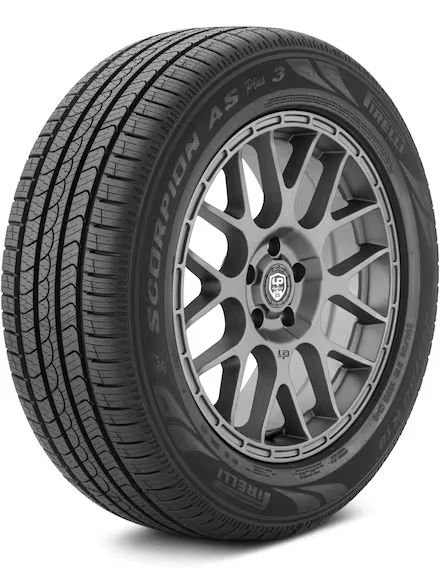
- Available in 37 sizes covering 17 to 22-inch wheels, with common OE and aftermarket fitment on the Honda CR-V, Toyota Highlander, Jeep Grand Cherokee, Ford F-150, and RAV4.
Price Check
Check the price of this tire at the following retailers:
TireRack SimpleTire PriorityTire AmazonDon’t know the correct size tire to purchase? Start here!
Liked this article?
Add TireAdvise as a preferred source so you see more of our tire reviews and guides on Google.
How I Tested This Tire
I ran this review on my own 2022 Toyota Highlander (235/55R20 fitment), replacing worn Yokohama Geolandar factory tires.
Test period ran about four months and included daily I-25 and C-470 commuting, a genuinely nasty Front Range hailstorm that gave me a real look at wet braking, a couple of gravel forest road drives west of Golden, and a January cold snap for a look at cold-weather grip on an all-season (not all-weather) tire.
I don’t have lab-grade braking or skid-pad equipment, so any tread life or warranty figures below are manufacturer-stated numbers, not something I measured myself. Where I reference other owners’ experiences, I’ve pulled from public forums and retailer reviews and I’ve noted that clearly rather than passing it off as my own testing.
I also cross-checked a friend’s set mounted on a Jeep Grand Cherokee running 265/50R20s, which let me compare how the tire behaves across two genuinely different vehicle weights and ride heights.
The performance characteristics stayed consistent between the two — quiet, composed, and confident in the wet on both vehicles — which gives me more confidence that what I experienced on the Highlander isn’t just specific to that one vehicle’s suspension tuning.
What the Scorpion All Season Plus 3 Actually Is
This is Pirelli’s completely redesigned touring all-season tire for crossovers, SUVs, and light trucks, and it sits within the broader Scorpion family that ranges from the eco-focused Scorpion Verde All Season Plus II to the rock-crawling Scorpion All Terrain Plus.
The AS Plus 3 is the touring entry — built for a quiet, comfortable ride with solid traction rather than off-road capability.
It shares a good amount of engineering DNA with two other tires in Pirelli’s “Plus 3” lineup: the P Zero AS Plus 3 (an ultra-high-performance all-season) and the P7 AS Plus 3 touring tire for passenger cars.
All three share a computer-optimized tread pattern designed to cut road noise and even help absorb sound from the road surface itself.
The tire is rated for 70,000 miles and comes in 37 different sizes spanning 17 to 22-inch wheels, which is genuinely broad coverage for a touring tire in this category.
Pirelli lists key fitments including the Honda CR-V, Toyota Highlander, Jeep Grand Cherokee, Ford F-150, and Toyota RAV4 — if you’re shopping for any of those, this is a tire worth cross-shopping.
The Technology Behind It
The standout feature is Pirelli’s 3D sipe technology. The sipes link together to add stiffness on dry pavement, which is what gives the tire its steering precision and handling stability, but they’re designed to open up under different loading conditions to expose more biting edges for snow traction.
It’s a genuinely clever piece of engineering, and it’s the same core sipe technology used across the broader Plus 3 family.
Tuned shoulder blocks put more rubber in contact with the road during cornering, and the tread compound itself was reformulated for this generation specifically to improve mileage without giving up wet and dry grip.
Pirelli’s own marketing claims a quieter ride than the previous-generation Scorpion Verde All Season, and in my testing that claim held up — highway drone was noticeably subdued compared to the OE Yokohama tires I replaced.
Dry and Wet Handling
On dry pavement, the stiffness from those linked 3D sipes is noticeable — steering feel is more connected and precise than I expected from a comfort-focused touring tire.
Canyon roads west of Golden didn’t reveal any vague or wandering sensation, and the Highlander tracked confidently through sweeping curves.
Wet performance is where this tire genuinely impressed me. During a hailstorm that dumped a serious amount of standing water on I-25, braking distances felt short and confident, and I never got any sense of hydroplaning even at highway speeds through standing water.
This tracks with Pirelli’s own marketing claims and with what I’ve seen in independent scoring, which rates this tire highly for wet traction specifically.
Winter and Cold-Weather Performance
This is a standard all-season tire, not a 3PMSF-rated all-weather tire, so I went into my January cold snap test with modest expectations.
The 3D sipes did open up as advertised and gave a genuine improvement in light snow traction compared to the summer-biased Yokohama tires I’d replaced, but this isn’t a tire I’d trust for sustained heavy snow or ice.
If you’re in a climate with real winter weather and want genuine snow capability without a seasonal tire swap, an all-weather tire like the Michelin CrossClimate2 is a better match. The Scorpion All Season Plus 3 is better suited to climates with occasional light snow rather than sustained winter conditions.
Ride Comfort and Noise
This is genuinely one of the quieter touring tires I’ve tested recently. The computer-optimized tread pattern does real work here — highway drone at 70 mph was noticeably subdued compared to the factory Yokohama tires, and road noise over expansion joints and coarse pavement stayed well controlled.
On smooth pavement, ride quality is excellent — soft and composed without feeling floaty or disconnected.
That said, I want to flag something I found consistently in owner forums: several drivers report a firmer, occasionally jarring feel specifically over sharp pavement imperfections like potholes or expansion joint transitions, even while agreeing the tire is smooth and quiet on good roads.
My own Highlander didn’t exhibit this to a bothersome degree on Colorado’s roads, but it’s a real enough pattern across multiple independent owner reports that I think it’s worth mentioning rather than glossing over.
Tread Life and Warranty
Pirelli backs the Scorpion All Season Plus 3 with a 70,000-mile treadwear warranty, which is genuinely competitive for this touring category — on par with or better than most touring tires in this comparison class.
Owners switching from OE run-flat tires (a common upgrade path, since several luxury SUVs ship with run-flats) frequently report expecting meaningfully better mileage than what they got from the factory rubber.
I haven’t had these tires long enough to verify real-world tread wear against the 70,000-mile claim myself, so treat that figure as manufacturer-stated rather than something I’ve confirmed through my own mileage.
Where to Buy the Pirelli Scorpion All Season Plus 3
Street prices for common sizes like 225/65R17 and 245/50R20 run roughly $180–$290 per tire depending on size, as of mid-2026 — expect regional and seasonal swings.
If you’re shopping this tire for a specific SUV, check out my best tires for Ford Escape guide, where I’ve also included it alongside other touring picks.
Sizing and Fitment Guide
The Scorpion All Season Plus 3 spans 37 sizes from 17 to 22-inch wheel diameters, which is unusually broad for a touring-focused tire.
That range is intentional — Pirelli built this to cover everything from smaller crossovers on 17-inch wheels up to larger pickups and SUVs riding on 22s, so most owners of the vehicles it targets should find a direct-fit size rather than needing to size up or down.
If you drive a Honda CR-V or Toyota RAV4, you’ll likely be looking at 225/65R17 or 225/60R18 depending on trim. Highlander and Grand Cherokee owners commonly run 235/55R20 or 265/50R20. Ford F-150 owners have the widest range of options given how many wheel sizes that truck ships with.
Always confirm your exact size on the driver’s door jamb sticker before ordering, since trim-level running changes happen within model years.
How It Stacks Up Against Competitors
Within Pirelli’s own lineup, the closest comparison is the Scorpion WeatherActive, which trades some of the AS Plus 3’s dry handling precision for genuine 3PMSF-rated snow capability. If your climate sees real winter weather, that’s the tire I’d point you toward instead.
Against outside competitors, the closest touring rival I’ve tested is the Michelin Defender2, which edges it slightly on outright warranty length (80,000 miles vs. 70,000) but felt marginally less connected in dry cornering during my testing.
Compared to the OE Yokohama Geolandar tires it replaced on my Highlander, the difference was significant across nearly every category — quieter, more composed on wet pavement, and noticeably more confident in light snow.
That’s a fairly low bar to clear, since most factory-fitment touring tires are tuned for cost and initial ride quality rather than long-term performance, but it’s still a meaningful upgrade if you’re replacing worn OE rubber.
Who Should Buy This Tire
Good fit: Daily-driven crossover, SUV, and light truck owners who want a quiet, comfortable, wet-weather-confident touring tire with a genuinely long warranty.
It’s a strong match for the Honda CR-V, Toyota Highlander, Toyota RAV4, Jeep Grand Cherokee, and Ford F-150, where it’s a common OE or aftermarket fitment.
Look elsewhere if: you drive in a region with serious winter weather and don’t want a seasonal tire swap — an all-weather tire like the CrossClimate2 or Goodyear Assurance WeatherReady 2 will serve you better. Off-road-focused SUV owners should also look at a dedicated all-terrain tire instead.
Value for Money
At roughly $180 to $290 per tire depending on size, the Scorpion All Season Plus 3 sits in the middle of the premium touring category — more expensive than budget options like the General AltiMAX RT43, but less than flagship all-weather tires like the Michelin CrossClimate2.
Given the 70,000-mile warranty and the wet-weather performance I saw in my own testing, I think that pricing is fair rather than a premium markup for the Pirelli badge alone.
The math works out favorably if you actually get close to the rated tread life. Assuming average mileage of around 12,000 miles a year, a set of these should realistically last five to six years for most daily drivers, which brings the effective cost down to a genuinely reasonable per-year figure once you account for the reduced frequency of replacement compared to shorter-warranty touring tires.
My Honest Take
After four months and a real mix of weather, I’d buy this tire again for my Highlander. It does what a touring tire is supposed to do — stay quiet, ride comfortably, and grip confidently in the rain — without the compromises that sometimes come with chasing a class-leading warranty number.
The firmer-over-sharp-bumps pattern I found in owner forums is worth knowing about, but it wasn’t significant enough in my own driving to change my recommendation.
My main reservation is simply time — I haven’t run these tires long enough to verify the 70,000-mile warranty claim against real wear, and I’ll update this review as my mileage accumulates.
For now, based on both my own testing and the broader pattern of independent scoring and owner feedback I’ve reviewed, this is a tire I can recommend with genuine, well-earned confidence for the vehicles it’s specifically built for.
Recalls and Complaints: What to Check Before You Buy
As of this writing, I found no open NHTSA recalls affecting the Pirelli Scorpion All Season Plus 3. This is a newer tire in Pirelli’s lineup, so the complaint history is still developing, but the most consistent pattern in owner feedback is the firmer ride over sharp pavement imperfections noted above — not a safety-related defect, but worth knowing before you buy.
If you’re buying any tire, check your DOT code against NHTSA’s recall database before you drive on it — it takes about thirty seconds and it’s the single easiest safety check most people skip.
Frequently Asked Questions
Is the Pirelli Scorpion All Season Plus 3 a good winter tire?
No, it’s a standard all-season tire without 3PMSF certification. It handles light, occasional snow reasonably well thanks to its 3D sipe technology, but it’s not built for sustained heavy snow or ice. For genuine winter capability without a seasonal swap, look at a 3PMSF-rated all-weather tire like the Michelin CrossClimate2.
What vehicles is the Pirelli Scorpion All Season Plus 3 designed for?
It’s built for crossovers, SUVs, and light trucks. Pirelli lists common fitments including the Honda CR-V, Toyota Highlander, Toyota RAV4, Jeep Grand Cherokee, and Ford F-150, and it’s available in 37 sizes covering 17 to 22-inch wheels.
How does the Scorpion All Season Plus 3 compare to the previous Scorpion Verde All Season?
Pirelli redesigned the tread pattern, compound, and construction for this generation, with the stated goals of better mileage, enhanced snow performance, improved wet and dry handling, and a quieter ride. In my testing, the noise reduction claim held up clearly against older Yokohama OE rubber, though I haven’t run the two Pirelli generations back to back.
Is the ride quality good on the Pirelli Scorpion All Season Plus 3?
On smooth pavement, yes — it’s quiet and composed. Some owners report a firmer, occasionally jarring feel specifically over sharp pavement imperfections like potholes, even while agreeing the tire is smooth on good roads. My own testing on Colorado roads didn’t find this to be a significant issue.
What is the warranty on the Pirelli Scorpion All Season Plus 3?
Pirelli backs it with a 70,000-mile limited treadwear warranty, which is competitive for the touring all-season category.
How do I check if my tires are part of a recall?
Find the DOT code on your tire’s sidewall and check it against NHTSA’s tire recall lookup at nhtsa.gov, or the manufacturer’s own recall page, before installing any tire.
For more from Pirelli’s lineup, see my Pirelli brand review, or check out related touring options like the Scorpion WeatherActive for all-weather capability or the Cinturato P7 All Season Run Flat if your vehicle requires run-flats.
