

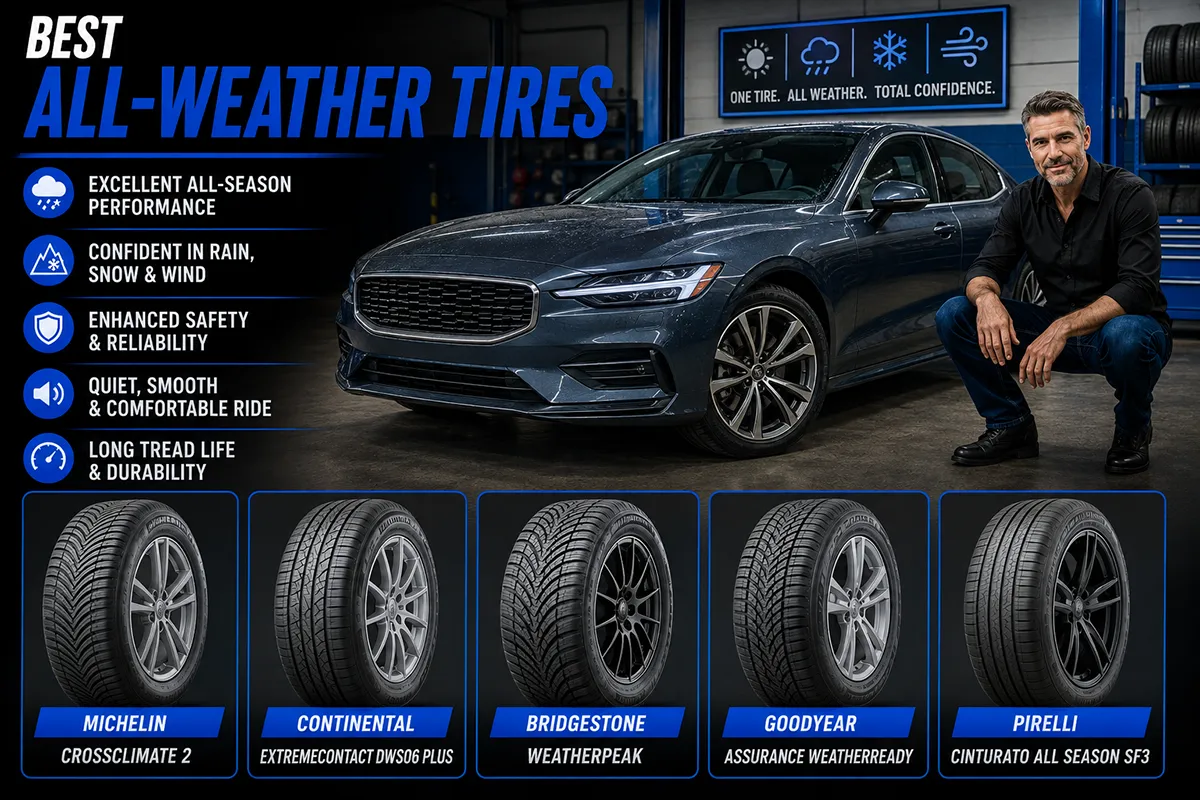
Plenty of “all-weather” lists quietly slip in a standard all-season touring tire that never earned the Three-Peak Mountain Snowflake certification defining the category — this guide only includes tires that actually carry it. Built from manufacturer specifications, aggregated owner data, and independent test results, here’s what genuinely holds up across wet, dry, and winter conditions, by priority.
- Best overall: Michelin CrossClimate2.
- Most reliable in snow: Goodyear Assurance WeatherReady2.
- Best for severe winter conditions: Nokian Remedy WRG5.
- Best premium option: Vredestein Quatrac Pro+.
- Best for wet performance: Bridgestone WeatherPeak.
- Best for SUVs and crossovers: Pirelli Scorpion WeatherActive.
- Best budget-friendly pick: Toyo Celsius II.
- Full definition of what actually qualifies as “all-weather,” a recalls check, and vehicle-type guidance are below.
Liked this article?
Add TireAdvise as a preferred source so you see more of our tire reviews and guides on Google.
What Actually Makes a Tire “All-Weather” (Not Just All-Season)
This distinction matters more than most buying guides let on, because the two terms get used almost interchangeably in casual conversation and even in some retailer listings.
A genuine all-weather tire carries the Three-Peak Mountain Snowflake (3PMSF) certification on its sidewall — the same standardized snow-traction test that dedicated winter tires must pass, requiring at least 10% better snow traction than a reference all-season tire.
A standard all-season touring tire, however well-reviewed or comfortable, does not carry this certification and has not passed this test, regardless of how confidently it’s marketed for “year-round” use.
This is the single most common gap in competing buying guides, including an earlier version of this one: tires like Continental’s PureContact LS, BFGoodrich’s Advantage Control, and Pirelli’s Cinturato All Season SF2 are genuinely good all-season touring and performance tires, but none of them carry 3PMSF certification, which means none of them are actually all-weather tires by the definition that matters — the one that determines whether the tire is legally compliant in winter-tire-mandate regions and whether it delivers the severe-snow traction the “all-weather” label implies.
Every tire in this guide was checked against manufacturer specification sheets to confirm 3PMSF certification before inclusion.
How These Were Evaluated
This comparison draws on manufacturer specifications, aggregated owner reports, UTQG ratings, and independent traction, braking, and tread-wear testing data for each tire, cross-referenced against current product generations rather than discontinued or superseded models.
Several tires in this category have been quietly replaced by newer versions in the past year or two — Goodyear’s WeatherReady became the WeatherReady2, Nokian’s WR G4 became the Remedy WRG5, and Toyo’s Celsius became the Celsius II — and a surprising number of buying guides still reference the outgoing generation by name. This guide reflects current-generation products throughout.
Particular weight was given to how each tire’s real-world character matches specific vehicle types and driving priorities — sedan and compact-car owners generally prioritize comfort and fuel efficiency differently than SUV and crossover owners who need higher load ratings and reinforced sidewalls.
Where specific tread-life figures, warranty numbers, or independently reported comparisons are cited, the source is noted rather than presented as a personal measurement.
Quick Comparison: 11 Best All-Weather Tires
| Tire | Best For | Approx. Price/Tire | 3PMSF Rated | Warranty |
|---|---|---|---|---|
| Michelin CrossClimate2 | Best overall | $175–$225 | Yes | 60,000–85,000 mi (size dependent) |
| Goodyear Assurance WeatherReady2 | Snow reliability | $165–$215 | Yes | Not specified |
| Nokian Remedy WRG5 | Severe winter conditions | $170–$220 | Yes | 45,000 mi |
| Vredestein Quatrac Pro+ | Premium option | $180–$235 | Yes | 50,000 mi |
| Bridgestone WeatherPeak | Wet performance | $140–$200 | Yes | 60,000 mi |
| Firestone WeatherGrip | Everyday drivers | $130–$180 | Yes | 60,000 mi |
| Falken Aklimate | Newest entrant, value | $135–$180 | Yes | 60,000 mi |
| Toyo Celsius II | Budget-friendly | $115–$165 | Yes | 65,000 mi |
| Pirelli Scorpion WeatherActive | SUVs and crossovers | $160–$215 | Yes | Not specified |
| Kenda Vezda Touring 4S | Ultra-budget | $95–$135 | Yes | 55,000 mi |
| Continental SecureContact AW | Comfort and longevity | $170–$220 | Yes | Not specified |
Prices are street prices at major online retailers for common sedan and crossover sizes (215/55R17 to 235/60R18) as of mid-2026 — larger SUV and truck-compatible sizes run above these ranges, and expect regional and seasonal swings on top of that.
1. Michelin CrossClimate2: Best Overall

Price Check
Check the price of this tire at the following retailers:
The CrossClimate2 remains the tire to beat in this category, and it’s worth clarifying up front: Michelin has confirmed the newer CrossClimate3, launched in Europe in mid-2025, will not reach North America for several years, so the CrossClimate2 is not an outgoing product here — it’s the current flagship, and Michelin’s own internal testing reportedly shows it outlasting the Goodyear WeatherReady2 by more than 23,000 miles.
Michelin’s V-shaped tread pattern with directional grooves and beveled edges actively evacuates water while maintaining constant road contact, and thousands of biting-edge sipes grip snow and ice with genuine tenacity for a non-winter-specific tire.
The compound remains pliable in cold temperatures while staying stable in warmer conditions, delivering roughly 85–90% of a dedicated winter tire’s snow performance — enough for all but the most extreme winter conditions. Warranty coverage varies by size, running from 60,000 miles up toward 85,000 on lighter passenger-metric fitments, significantly higher than most competitors in this category.
Pros: Genuine snow and ice performance for a non-winter tire, industry-leading tread-life warranty, confirmed as Michelin’s current North American flagship for years to come.
Cons: Premium price, road noise more noticeable than the quietest options here.
2. Goodyear Assurance WeatherReady2: Most Reliable in Snow
Price Check
Check the price of this tire at the following retailers:
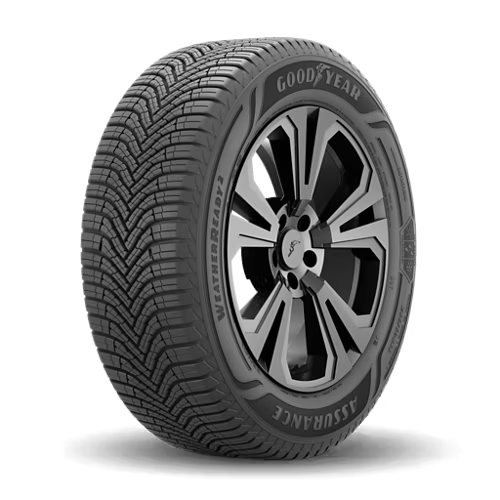
Goodyear replaced the original Assurance WeatherReady with the WeatherReady2, and the update is a genuine improvement rather than a rebrand — Michelin’s own comparative testing (reported by Michelin, so read with that context in mind) shows the WeatherReady2 wearing faster than the CrossClimate2, but independent owner reports and Goodyear’s own data continue to place it among the strongest options specifically in snow-packed and icy conditions.
Goodyear’s Weather Reactive Technology uses a soybean-oil-infused compound that stays flexible in frigid temperatures when other tires stiffen and lose grip, and 3D TredLock Technology creates interlocking microgrooves that activate as biting edges when cornering on snow.
A self-cleaning tread design with sweeping grooves actively pushes snow and slush away from the contact patch, preventing the dangerous compaction that degrades performance in lesser all-weather tires through a winter season.
Pros: Genuine strength in snow-packed and icy conditions specifically, self-cleaning tread design, 3PMSF certified with real cold-flex compound technology.
Cons: Shorter tread life than the CrossClimate2 by Michelin’s own comparative data, warranty mileage not specified by Goodyear.
3. Nokian Remedy WRG5: Best for Severe Winter Conditions
Price Check
Check the price of this tire at the following retailers:
Nokian’s Finnish engineering pedigree shows up clearly in the Remedy WRG5, the successor to the WR G4 and a tire built by a company for whom “winter” is closer to a permanent condition than a season.
An asymmetric tread pattern with polished grooves efficiently channels slush and water away from the contact patch, and Nokian’s Silent Sidewall technology keeps the tire composed even as temperatures drop well below freezing.
The tread’s gripping-tooth structures between tread blocks provide genuinely extraordinary traction on ice and packed snow, delivering control that meaningfully closes the gap with dedicated winter tires. Nokian backs the Remedy WRG5 with a 45,000-mile treadwear warranty and a 30-day satisfaction guarantee — shorter coverage than several competitors here, reflecting the softer, cold-optimized compound’s trade-off against pure longevity.
Pros: Best-in-comparison severe-winter and ice traction among genuine all-weather tires, reasonable fuel efficiency for its winter-focused compound.
Cons: Shortest warranty in this comparison, premium price, softer compound trades some dry-weather longevity for cold-weather grip.
4. Vredestein Quatrac Pro+: Best Premium Option

Price Check
Check the price of this tire at the following retailers:
The Quatrac Pro+ succeeds the Quatrac Pro, and Apollo Vredestein’s century of tire-manufacturing experience shows in the tire’s sophisticated asymmetric tread design — dense siping and specialized rubber on the inner portion maintains flexibility near freezing, while larger, more rigid tread blocks on the outer portion prioritize dry handling and high-speed stability.
On dry pavement, the Quatrac Pro+ delivers responsive steering and confident cornering that rivals dedicated summer tires, a genuine rarity in the all-weather category.
Wide circumferential grooves handle heavy rain confidently, and the winter-rated compound with dense siping provides real biting-edge traction on snow and ice.
Road noise is notably well-controlled for a tire with this much winter capability, making it a strong pick for drivers who want premium refinement alongside genuine all-weather performance.
Pros: Genuine dry-handling refinement rare in this category, well-controlled road noise, strong stability at highway speed.
Cons: Premium price, 50,000-mile warranty trails the CrossClimate2’s upper range.
5. Bridgestone WeatherPeak: Best for Wet Performance
Price Check
Check the price of this tire at the following retailers:
For drivers who face heavy rain more often than heavy snow, the WeatherPeak is built specifically around that priority.
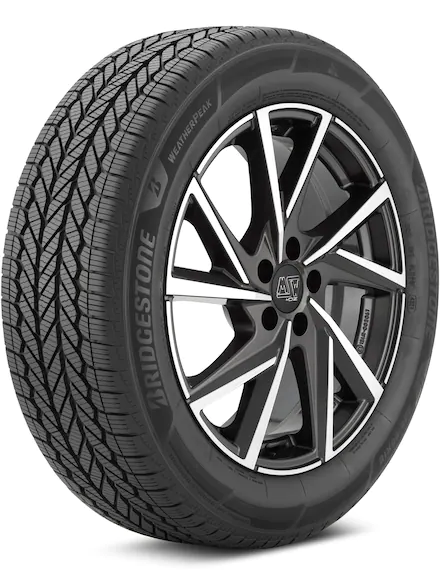
Bridgestone’s proprietary full-depth 3D sipes and an optimized tread pattern actively channel water away from the contact patch, and independent testing has shown wet braking distances measurably shorter than standard all-season tires — a genuine, safety-relevant margin during sudden downpours or standing water.
An open shoulder-slot design combined with wide circumferential grooves prevents water buildup beneath the tire, maintaining road contact even in genuinely heavy rain.
The tire also delivers respectable light-snow and dry-condition performance, so it isn’t a one-trick specialist, but wet-weather braking and hydroplaning resistance are where it genuinely separates itself from the rest of this comparison.
Pros: Genuinely shorter wet braking distances than standard all-season tires, strong hydroplaning resistance, reasonable mid-range price.
Cons: Not the strongest option here in severe snow or ice, dry handling is competent rather than exceptional.
6. Firestone WeatherGrip: Best for Everyday Drivers
Price Check
Check the price of this tire at the following retailers:
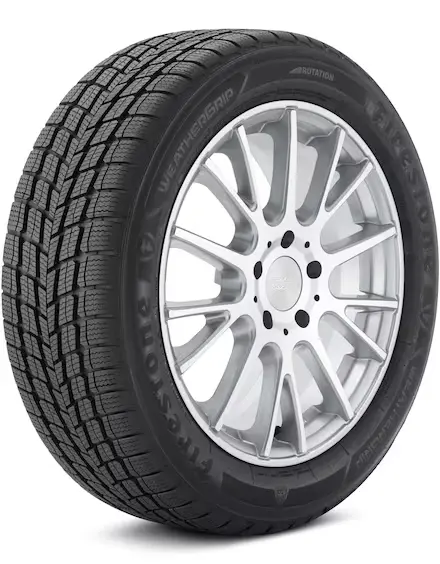
The WeatherGrip earns its place as the practical, no-drama choice for daily commuters and family vehicles. Full-depth grooves and open shoulder slots channel water away from the contact patch to reduce hydroplaning risk, while 3D sipes provide genuine wet traction without sacrificing dry handling.
Firestone’s TractionTech technology helps the tire maintain consistent grip as it wears, rather than losing capability disproportionately in the tire’s later life.
It carries 3PMSF certification confirming genuine light-to-moderate snow capability, and it fits a wide range of common sedans and compact crossovers, making it an easy, low-risk recommendation for drivers who want dependable year-round performance without needing to think much about tire selection beyond that. Firestone’s Quiet Track technology keeps road noise reasonable for the price category.
Pros: Genuine, dependable all-around performance at a reasonable price, wide size availability across common vehicles, real wear-resistant grip technology.
Cons: Not a specialist in any single category, moderate warranty relative to premium options.
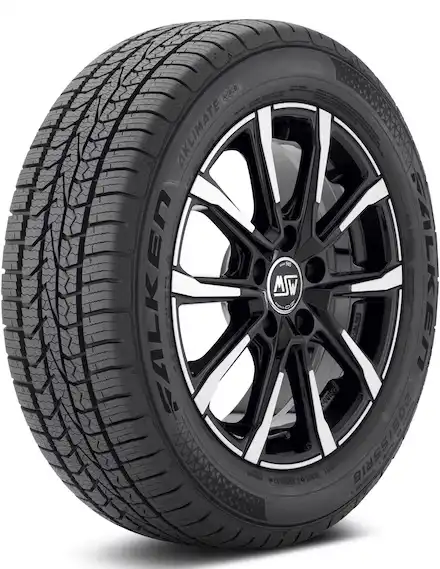
7. Falken Aklimate: Best New Entrant and Value
Price Check
Check the price of this tire at the following retailers:
This is the tire almost no other all-weather buying guide currently mentions, and that’s a genuine gap worth closing — the Aklimate is Falken’s newest entry into the genuine 3PMSF all-weather category, and it’s already earned a spot in Consumer Reports’ current tested all-weather lineup alongside far more established names.
Falken built the Aklimate specifically to compete with the segment leaders on both winter capability and price, rather than positioning it as a budget afterthought.
Independent testing places the Aklimate’s snow and wet performance competitively against tires costing considerably more, and Falken backs it with a 60,000-mile warranty that matches or exceeds several premium competitors in this comparison.
For drivers who want genuine, up-to-date all-weather capability without paying Michelin- or Vredestein-level pricing, the Aklimate is the strongest newly available option to watch.
Pros: Genuinely competitive performance against premium-tier tires, strong 60,000-mile warranty for the price, newest compound technology in this comparison.
Cons: Shorter independent track record than more established competitors, less widely stocked than the major players here.
8. Toyo Celsius II: Best Budget-Friendly Pick

Price Check
Check the price of this tire at the following retailers:
Toyo replaced the original Celsius with the Celsius II, and for budget-conscious drivers the update is a genuine improvement worth knowing about — several competing guides still reference the outgoing Celsius by name.
The Celsius II’s asymmetric tread pattern with varying block sizes provides confident handling in both dry and wet conditions, and higher sipe density on the inner tread area maintains flexibility in colder temperatures, a feature many budget tires skip entirely.
Wide circumferential grooves deliver remarkable wet-weather traction for the price, and the tire earns genuine 3PMSF certification rather than a watered-down winter claim.
Toyo backs the Celsius II with a 65,000-mile warranty — genuinely strong coverage for a budget-tier tire, and better than several premium options in this comparison on a pure cost-per-mile basis.
Pros: Genuine value with real 3PMSF certification, strong 65,000-mile warranty for the price, respectable wet-weather traction.
Cons: Road noise increases more noticeably as the tire wears, not built for spirited or high-speed driving.
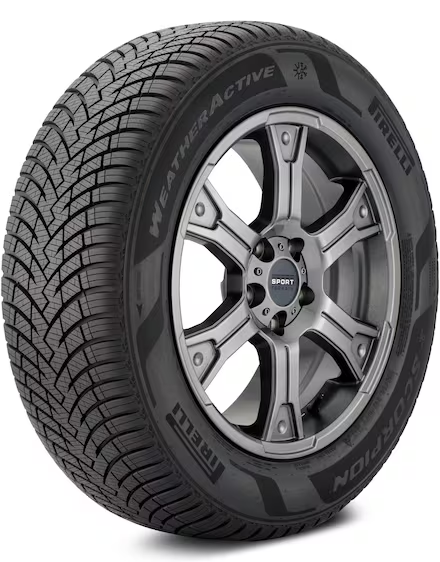
9. Pirelli Scorpion WeatherActive: Best for SUVs and Crossovers
Price Check
Check the price of this tire at the following retailers:
SUVs and crossovers carry more weight and sit higher than sedans, which changes what a tire needs to deliver — reinforced sidewalls, higher load ratings, and stable handling despite a higher center of gravity.
The Scorpion WeatherActive is Pirelli’s genuine 3PMSF-certified all-weather tire built specifically for this vehicle category, distinct from Pirelli’s Cinturato All Season SF2, which is a strong performance all-season tire but does not carry the same all-weather certification.
The tire’s reinforced construction and wider circumferential grooves handle the increased ground pressure that SUVs exert while maintaining confident wet-weather hydroplaning resistance.
Winter traction benefits from Pirelli’s dense siping pattern, and the tire maintains composed handling despite the added mass and higher rollover-relevant center of gravity that heavier vehicles present.
Pros: Genuine SUV/crossover-specific construction and load ratings, real 3PMSF winter certification, confident wet-weather stability for a heavier vehicle.
Cons: Premium price, warranty mileage not specified by Pirelli.
10. Kenda Vezda Touring 4S: Best Ultra-Budget Pick
Price Check
Check the price of this tire at the following retailers:
For drivers who want genuine 3PMSF certification at the lowest realistic price point in this comparison, the Vezda Touring 4S delivers real all-weather capability without premium-brand pricing.
It won’t match the CrossClimate2 or Quatrac Pro+ on refinement or outright grip, but it passes the same severe-snow traction test those tires do, which is a meaningful distinction from a cheap all-season tire marketed loosely as “year-round.”
Kenda backs the Vezda Touring 4S with a 55,000-mile warranty, respectable for its price category, and real owner reports describe it as a dependable, no-frills choice for commuter vehicles and second cars where ultimate performance matters less than genuine winter-legal capability on a tight budget.
Pros: Genuine 3PMSF certification at the lowest price point here, respectable warranty for the price, dependable for straightforward commuter use.
Cons: Doesn’t match premium tires on refinement, comfort, or ultimate grip in any single category.
11. Continental SecureContact AW: Best for Comfort and Longevity
Price Check
Check the price of this tire at the following retailers:
Continental’s genuine all-weather entry is the SecureContact AW — distinct from the PureContact LS, a well-regarded touring all-season tire that does not carry 3PMSF certification and shouldn’t be recommended as a true all-weather pick, as some competing guides mistakenly do.
The SecureContact AW carries Continental’s comfort-focused engineering, including their noise-reduction tread design and cushioned sub-tread layer, into a tire that actually earns the winter certification the category implies.
Continental’s silica-enhanced compound resists wear while maintaining grip across conditions, and the tire’s wide circumferential grooves handle wet roads confidently.
For drivers who specifically want Continental’s known comfort and low-noise characteristics but need a tire that’s genuinely certified for real winter conditions rather than just labeled for them, this is the correct pick — not the PureContact LS.
Pros: Genuine 3PMSF certification with Continental’s comfort-focused engineering, quiet ride, confident wet-weather grip.
Cons: Warranty mileage not specified by Continental, premium price relative to the budget options here.
Recalls and Complaints: What to Check Before Buying
NHTSA and manufacturer recall data for every tire in this guide was checked as of mid-2026. None of the specific all-weather passenger models reviewed above currently have an open recall. One note worth flagging for context: Michelin has recalled several Agilis CrossClimate C-Metric commercial van tires in recent years over insufficient snow traction relative to their Alpine Symbol marking — this is a different product line built for commercial vans, not the CrossClimate2 passenger tire featured above, and does not affect it.
Before installing any tire, new or used, check the DOT code against NHTSA’s recall database — it takes about thirty seconds and is the single easiest safety check most people skip.
Choosing the Right All-Weather Tire for Your Vehicle
Sedans and compact cars generally benefit most from comfort- and efficiency-focused picks like the Michelin CrossClimate2 or Firestone WeatherGrip.
SUVs and crossovers need higher load ratings and reinforced sidewalls — the Pirelli Scorpion WeatherActive and Goodyear Assurance WeatherReady2 are built with these vehicles specifically in mind.
Performance-oriented vehicles benefit from the Vredestein Quatrac Pro+’s genuinely sharper dry handling relative to the rest of this category.
Regions with severe, sustained winters should lean toward the Nokian Remedy WRG5, which most closely approaches dedicated winter-tire traction while remaining street-legal and comfortable the rest of the year. Regions with genuinely extreme winter conditions — heavy, sustained snowfall, regular sub-zero temperatures — should still consider a dedicated winter tire on a second set of wheels rather than relying on any all-weather option; even the strongest all-weather tires here trade some severe-ice performance for year-round versatility.
Budget-conscious drivers shouldn’t assume “cheap” means “not actually all-weather” — the Toyo Celsius II, Falken Aklimate, and Kenda Vezda Touring 4S all carry genuine 3PMSF certification at meaningfully lower prices than the premium tier.
Maintaining All-Weather Tires
Rotate every 5,000 to 7,000 miles, following the correct rotation pattern for your vehicle’s drivetrain (FWD, RWD, or AWD), which can extend tire life by up to 20%.
Check pressure at least monthly, always against the door jamb sticker rather than the maximum PSI printed on the tire sidewall. Pressure drops roughly 1 PSI for every 10°F temperature decrease, which matters more for all-weather tires that see genuine seasonal swings than for tires used only in mild conditions.
Have alignment checked annually, or immediately if you notice uneven wear, pulling to one side, or steering vibration — even slight misalignment causes tires to drag rather than roll freely, accelerating wear and reducing fuel efficiency.
Watch for genuine replacement signs: tread depth below 4/32″ (consider replacement closer to this threshold than the legal 2/32″ minimum to preserve wet and snow traction), uneven wear patterns, visible sidewall cracks or bulges, or decreased wet-weather performance as the tire ages.
Frequently Asked Questions
What’s the difference between all-weather and all-season tires?
All-season tires are designed for moderate conditions and are not required to pass any severe-snow traction test. All-weather tires carry the Three-Peak Mountain Snowflake (3PMSF) certification, meaning they’ve passed a standardized test demonstrating at least 10% better snow traction than a reference all-season tire — the same certification standard dedicated winter tires must meet.
How do all-weather tires perform compared to dedicated winter tires in deep snow?
All-weather tires handle light to moderate snow well, but in deep snow (over 6 inches) or on genuinely icy roads, dedicated winter tires still maintain a real performance advantage. All-weather tires lack the most aggressive siping patterns, softest cold-weather compounds, and most aggressive tread designs that true winter tires use. For regions with frequent heavy snowfall or ice storms, winter tires remain the safer choice.
Are all-weather tires legal in winter-tire-mandate regions?
Most all-weather tires bearing the 3PMSF symbol meet legal requirements in regions with winter tire mandates, including most Canadian provinces. Regulations vary by location, so check local laws — some mountainous regions with extreme winter conditions may still require dedicated winter tires during certain months regardless of 3PMSF certification.
How much do all-weather tires reduce fuel economy?
All-weather tires typically reduce fuel efficiency by about 3–5% compared to summer tires due to increased rolling resistance from their more aggressive tread patterns and softer compounds. This is a smaller impact than swapping between all-season and dedicated winter tires seasonally, and several current models — including the Vredestein Quatrac Pro+ — incorporate low-rolling-resistance technology to minimize the effect further.
What’s the average lifespan of an all-weather tire?
Most quality all-weather tires last between 45,000 and 65,000 miles depending on driving conditions and maintenance, with the Michelin CrossClimate2 reaching as high as 85,000 miles on some sizes. All-weather tires generally wear somewhat faster than dedicated summer tires, since their softer compounds are engineered to stay flexible in cold temperatures.
Is the Michelin CrossClimate3 available in the US yet?
No. Michelin has confirmed the CrossClimate3, currently sold in Europe, will not reach North America for several years. The CrossClimate2 remains Michelin’s current flagship all-weather tire in the US market and is not being phased out.
